
Sheldon Brown's
Bicycle Glossary L

|

Labyrinth seals work very well as long as the bearing assembly is not immersed.
The illustration shows a standard hub, but similar seals are used on some  other bearing applications as well.
Since hardly anybody rides in a skirt anymore, this inferior design is pretty-much obsolete. Conventional diamond frames have several advantages over the Victorian lady's bicycle. They are:
 Laprade Seatpost

This has been done by encumbering fork ends with extra hardware, ridges or lumps that keep the wheel sort-of attached even if it has been installed by someone who doesn't know what he or she is doing. Unfortunately, this means that the quick-release mechanism must be re-adjusted each time it is used, seriously slowing down the operation.
Since this extra stuff was installed as a defense against frivolous lawsuits by ambulance-chasing shysters, the extra bumps are sometimes known as "lawyer lips" or "lawyer tabs."
As "lawyer lips" have become the norm, they have gradually become more important than they originally were, for two reasons:
Left-threaded fasteners are turned counter-clockwise to tighten them.
Left threads are found on left pedals, some bottom-bracket parts, internal parts of freewheels, and sprockets that thread onto older freewheels from the left side.
Left-side pedals and right-side bottom bracket cups use left-hand threading because of the phenomenon called "precession." It is somewhat counterintuitive, because the direction of rotation caused by the precession is opposite the (much smaller) torque exerted by bearing friction.
See the Pedals entry in this Glossary , and Jobst Brandt's article on Left-Hand Threads on this site for a detailed explanation of precession.
Spoke nipples and the expander bolts that hold bar-con shifters in place often appear to have left threads, because they are approached from the opposite direction of most fasteners.
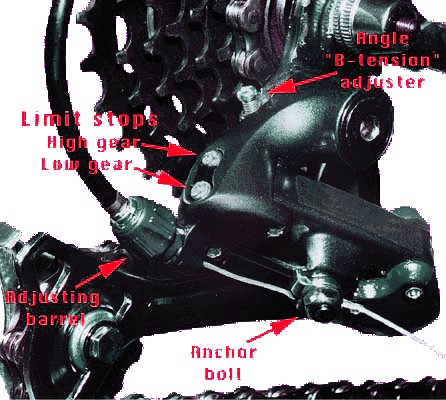
See my article on Derailer Adjustment for more details.
Locknuts are used to secure bearing adjustment of most hubs, headsets, pedals and sidepull brakes. Most hubs use locknuts to secure the cones so that they will stay in adjustment. These locknuts are the outermost parts which are screwed onto the axle, and their outer surfaces press against the insides of the fork ends of the frame. The locknuts are therefore the reference point by which axle width and dishing are measured.
Cassette and Fixed-Gear (Track) Hub Threaded Outer Sprocket/ Lockring Threading
| Brand and model | Threading | Note |
|---|---|---|
| Campagnolo cassettes (all threads external on lockring) | ||
| 8-speed | 29 x 1 mm | Different outside diameters for 11T or 12-14T outer cog |
| 9- and 10-speed 1996-1999 | 26 x 1 mm | Different outside diameters, for 11T or 12-14T outer cog |
| 9- and 10-speed 2000- | 27 x 1 mm | Different shapes: may not be compatible |
| 11-speed | 27 x 1 mm | |
| Shimano cassettes | ||
| Uniglide (most) smallest sprocket | 1.37 x 24 TPI external on hub | Threading same as track cogs, SunTour New Winner 7-speed outer sprocket, English BB lockring |
| Dura-Ace Uniglide, 11T smallest sprocket | 32 mm (approx.) x 24 TPI external on hub | Smaller thread diameter to permit 11T outer sprocket. |
| Hyperglide lockring | 30 mm (approx) x 24 TPI external on lockring | Different outside diameters for 11T or larger sprocket |
| Capreo/Chosen lockring | 22 x 1 mm Capreo, 22 mm x 30 TPI Chosen (approx), external on hub | Smaller diameter to work with 9T sprocket |
| Fixed Gear lockring (Left threaded) | ||
| Campagnolo, Phil Wood | 1.32 vx 24 TPI | |
| English | 1.29 x 24 TPI | Fits most U.S., English, and Asian fixed-gear hubs. Also used on older English coaster brakes with threaded sprocket |
| French | 33 x 1 mm | |
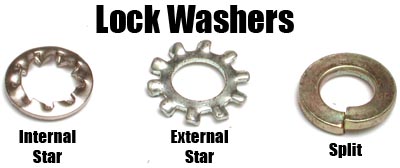 Lockwasher
Threadlockers are mainly used for threads that are not intended to be fully tightened: adjustment screws and the like.
There are very few good applications for threadlockers in bicycle work. They include:
If these are overtightened, they can "mushroom" the ends of the cantilever bosses, causing the brake to bind up.
French and Italian fixed cups are threaded in the wrong direction, so there is a tendency for them to loosen up in use.
Many mounting rings are tightened only against the ends of the bearing cartridge rather than having a shoulder or lockring that bears against the end of the bottom-bracket shell.
Low gears make the pedals easy to push, but you need to turn them faster to get the bike to move at a good speed.
Low gears are achieved by using small chainwheels and large rear sprockets.
Low gears are used for climbing hills, or for starting up from a stop.
Up until the late 1950s, all spring loaded derailers were low-normal. Campagnolo's pioneering parallelogram-type rear derailer was high-normal, and most rear derailers made since then have been of the high-normal type.
The major advantage of high-normal rear derailers is that, when used with a low-normal front, both levers move in the same direction for double shifts. This makes it easier to perform a double shift with down-tube shift levers.
The major advantage of low-normal derailers is that they generally downshift a bit better than high-normal units.
Since the late 1990s, Shimano has attempted to revive the low-normal rear derailer design, using the trademark "RapidRise." This has met with increasing acceptance by cyclists.
Sun Tour used to make high-normal front derailers. The principal advantage of this was that the front and rear shift levers moved in the same direction to either raise or lower the gear, less confusing for beginner cyclists.
As mountain bikes became popular in the 1980s, the heel clearance issue became a serious problem, because mountain bikes generally used smaller frames than traditional designs, placing the seatstays lower. The riders' heels; banging into the ends of the brake cantilevers became a real concern.
The industry responded with a re-designed cantilever whose arms were angled up higher, and didn't stick out so far to the side. This fixed the heel clearance problem, but introduced problems of its own.
With low profile cantilevers, the mechanical advantage decreases as the brake shoe moves inward toward the rim, an undesirable characteristic which causes the braking performance to deteriorate sharply as the pads wear down.
See also my article on Cantilever Geometry.
Most newer cranks use the "low-profile" design: the bottom bracket is made shorter, and the crank runs outward at an angle from bottom bracket to pedal, giving improved heel clearance for riders who tend to pedal splay-footed.
Note: That a crank is "low-profile" says nothing about its tread width (a.k.a. "Q factor.") In fact most "low profile" cranks have fairly wide tread, but this has nothing to do with the "low-profile" design.
The trend toward wider tread resulted from the wider chainstays introduced with mountain bikes, and also the additional clearance required to keep the right crank from rubbing against the cage of the front derailer (newer front derailers optimized for triple chainwheels require more crank clearance than older front derailers did.)
Some frames use internal lugs, with a necked-down section that fits inside of the tube, rather than having a socket that the tube fits into.
Last Updated: by Harriet Fell