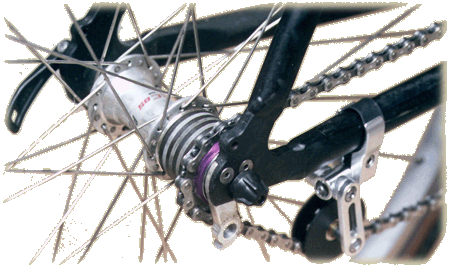
Chain size is specified by pitch and width. The pitch is the distance between rollers (1/2" on all modern bicycle chain). The width is the internal width where the sprocket teeth fit in. Bicycle chain comes in two basic widths:
Chains for derailer applications also come in various external widths. Newer clusters which have more sprockets use chain with thinner side plates and flush rivets.
For more information on chains, see my article on Chain Maintenance.
In the case of derailer geared bicycles, the chainline is not perfect in most gears. The worse the chainline, the worse the mechanical efficienty of the drive train.
"Correct" chainline for a derailer system is a matter of opinion, and depends on the intended use of the bicycle. There are two "simple" answers to the question of what constitutes proper chainline:
Chainline is measured from the centerline of the frame to the center of the chain.You can measure the front chainline directly with a simple ruler. Simply hold the ruler against the seat tube or down tube and measure the distance to the middle of the chainring teeth. In the case of triple chainwheel sets, measure to the middle chainring. In the case of doubles, measure to the halfway point between the two rings.
To measure rear chainline, the easiest way is to measure the distance from the inside of the rear fork end (or the outside of the axle locknut) to the middle of the sprocket. Double this, subtract it from the over-lock-nut dimension of the hub (or the frame spacing , which should be the same), then divide the result in half, and you have the rear chainline.
| Application | Dimension | Notes |
|---|---|---|
| Road Double | 43.5 | Shimano spec, measured to the midpoint between the rings. with typical 5 mm chainring spacing, this puts the inner at 41 mm, the outer at 46 mm. |
| Road Triple | 45 | Shimano spec, measured to the middle ring. |
| MTB Triple | 47.5-50 mm | Shimano spec, measured to the middle ring. 47.5 preferred, but for frames with oversized seat tubes, the longer dimension may be needed, because the fat tube places the derailer mechanism farther to the right. |
| Track/Coaster Brake Traditional One-Speed Most internal gear hubs | 40.5-42 mm | Older bikes with 110 spacing would be on the smaller end of this range Newer bikes with 120 mm spacing normally use 42 mm |
| Singlespeed MTB | 52 mm | Wider chainline need for chainstay clearance on MTBs. This is close to the chainline of the outer ring of a typical MTB triple |
| Rohloff Speedhub | 54 mm (58 mm w/13 tooth) | |
| Singlespeed MTB Alternate | 47.5 mm | White Industries ENO hubs use this chainline, which lines up with the middle position of a typical MTB triple. It's also fairly close to the outer position of a typical "road" double. |
I have measured a selection of track sprockets, single freewheels and hubs with respect to chainline (units are millimeters.) The "Chainline" column is the distance from them mounting shoulder to the center line of the sprocket teeth.To figure the actual chainline for a given combination, add the number from the "chainline" column of the sprocket or freewheel to the corrresponding "chainline" column of the hub chosen.
(If you can provide dimensions for additional models, please
send the info to me!)
| Fixed (Track) Sprockets | |||||
|---|---|---|---|---|---|
| Model/Type | Nominal Width | Chainline
(From Shoulder) | Measured width | Total thickness | Thread Thickness |
| Campagnolo | 3/32" | 7.0 | 2.0 | 8.0 | 7.8 |
| Campagnolo | 1/8" | 6.5 | 3.0 | 8.0 | 7.2 |
| E.A.I. | 3/32" | 7.13 | 2.2 | 8.23 | 8.05 |
| E.A.I. | 1/8" | 6.73 | 3.02 | 8.24 | 8.05 |
| Miche Quick Change Splined | 3/32" | 5.85/5.15 | 1.9 | 7.72 | 7.3 |
| Miche Quick Change Splined | 1/8" | 5.85/5.15 | 3.0 | 7.72 | 7.3 |
| Phil Wood | 3/32" | 5.86 | 2.3 | 7.01 | 7.01 |
| Phil Wood | 1/8" | 6.05 | 3.02 | 7.56 | 7.06 |
| Shimano Dura-Ace | 3/32" | 6.49 | 2.11 | 7.55 | 7.55 |
| Shimano Dura-Ace | 1/8" | 7.05 | 3.05 | 8.58 | 7.7 |
| Soma | 3/32" | 6.37 | 1.86 | 7.3 | 7.3 |
| Soma | 1/8" | 6.9 | 3.00 | 8.4 | 6.9 |
| Sugino Gigas | 1/8" | 7.0 | 3.0 | 8.5 | 7.5 |
| Sun Tour Superbe | 3/32" | 6.22 | 2.26 | 7.35 | 7.35 |
| Sun Tour Superbe | 1/8" | 6.93 | 3.05 | 8.46 | 7.5 |
| Surly New (2005) | 3/32 | 6.4 | 2.0 | 7.4 | 7.4 |
| Surly New (2005) | 1/8" | 5.9 | 3 | 7.4 | 7.4 |
| Surly Old | 3/32 | 5.28 | 2.05 | 6.31 | 6.31 |
| Surly Old | 1/8" | 5.07 | 2.7 | 6.42 | 6.42 |
| Single Speed Freewheels | ||||
|---|---|---|---|---|
| Model/Type | Nominal Width | Chainline
(From Shoulder) | Measured width | Total thickness |
| ACS | 3/32" | 7.96 | 2.16 | 9.04 |
| Shimano | 3/32" | 7.89 | 2.08 | 8.92 |
| Shimano | 1/8" | 8.67 | 3.0 | 10.17 |
| Tristar | 1/8" | 7.71 | 2.96 | 9.19 |
| White Industries | 3/32" | 8.73 | 2.17 | 9.82 |
| Single Speed and Fixed Gear Hubs | |||||||
|---|---|---|---|---|---|---|---|
| Model/Type | Track/MTB | OLD Spacing | Adjustable?* | Chainline
Center to Shoulder | Left Side | Right Side | Drillings |
| Campagnolo small flange 2002 | Track | 120 | Yes | 36 | Plain | Fixed | 28, 32, 36 |
| Campagnolo C-Record Large flange | Track | 120 | Yes | 35.9 | Plain | Fixed | 28, 32, 36 |
| Gold Tec | Track | 120, 130, 135 | Yes | 39.5 | Fixed | Fixed | 32, 36 |
| Miche | Track | 120 | Yes | 36.3 | Plain | Fixed | 28, 32, 36 |
| On-One Full Monty | MTB | 135 | No | 43.3 | Plain | Free | 32, 36 |
| Phil Wood Track | Track | 120, 126, 130 | No | 36.75 | Plain/Fixed/Free | Fixed | 28, 32, 36 |
| Phil Wood K.I.S.S. Off | MTB | 135 | No | 45.35 | Plain/Free | Fixed/Free | 32, 36 |
| Shimano Dura-Ace 7700 | Track | 120 | Yes | 35.3 | Fixed | 28, 32, 36 | |
| Shimano Dura-Ace 7700 Small Flange | Track | 120 | Yes | 35.3 | Fixed | 28, 32, 36 | |
| Shimano Dura-Ace 7600 Large Flange | Track | 120 | Yes | 35.4 | Fixed | 28, 32, 36 | |
| Sovos | Track | 112 | Yes | 33.5 | Free | Fixed | 36 |
| Spot | MTB | 135 | No | 47.25 | Plain | Free | 28, 32, 36 |
| Surly Track | Track | 120 | Yes | 36.22 | Free | Fixed | 32 |
| Surly 1 x 1 | MTB | 135 | Yes | 46.5 | Free | Fixed/Free | Drillings |
| Suzue Basic | Track | 117-120 | Yes | 34.74 | Free | Fixed | 28, 32, 36 |
| Suzue Promax (cartridge) | Track | 120 | Yes | 35.0 | Free | Fixed | 28, 32, 36 |
| Suzue Promax NJS | Track | 120 | Yes | 35.0 | Fixed | Fixed | 28, 32, 36 |
| Van Dessell | MTB | 135 | No | 45.9 | Free | Fixed | 32 |
| White Industries ENO | Track/MTB | 126, 130, 135 | No | 39.1 | Free | Fixed | 28, 32, 36 |
Thanks to John Dacey and Marten Gerritsen for some of these data.
"Adjustable" means that the hubs use conventional threaded axles, so you can increase the OLD spacing by removing the locknuts and adding spacer washers. If you add equal thicknesses to both sides, the chainline is unaffected, since it's measured from the middle outward. If you add more spacers to one side, you can change the chainline, but if you do this with a double-sided hub, you will render it unusable on one side or the other, since you'll be increasing the chainline on one side while decreasing it on the other.
For information on interchangeability, see: Bolt Circle Diameter.
This jams the crankset. Since you probably wouldn't have been shifting to the granny if you weren't already climbing, the sudden lock-up of the drive train deprives you of what little momentum you had, and you are very likely to stall and fall.
Chain suck is commonly caused by bent chainring teeth, dirty chains, or, occasionally, burrs on the teeth of new chainwheels.
Jonathan Levy has an extensive Web site about Chain Suck
For information on interchangeability, see: Bolt Circle Diameter.
A loose adjustment of the low-gear stop causes the chain to derail past the small chainring, but a tighter setting results in slow downshifting to the small ring.
In such cases, a good, if inelegant, solution is sometimes to install a chain deflector, an anti-derailment device that clamps to the seat tube. These products, such as the 3rd Eye Chain Watcher ® and the N-Gear Jump Stop ® set up a barrier preventing the chain from overshooting the small ring, no matter how loose the low-gear stop is set. This allows the low-gear stop to be set to allow the derailer to move farther inboard for faster, more precise shifting, even under some load. These devices can often save the day when extra-wide range gearing is used on a mountain bike or tandem.


Genuine chamois is expensive and requires extra care in washing and treatment to preserve it, so it is no longer in common use for cycling shorts. Most newer cycling shorts have artificial "chamois" made of specially woven cloth.
In the 2005 model year, there was a fad for "retro choppers" These are not true wheelie bikes, but have styling similar to a "chopper" motorcycle. They'll generally feature extended forks with very slack angles and a very laid-back seat tube angle as well. The resulting riding position is midway between a conventional upright bike and a recumbent. Retro choppers usually have unusually wide rear tires, and medium width front tires. Choppers tend to be heavy, sluggish bikes, suitable for short leisurly rides in flat terrain.
Cinelli is especially noted as a manufacturer of handlebars , handlebar stems and lugs.
Practically all top-of-the-line racing bikes in the 1970s were equipped with Cinelli handlebars and stems.
Cinelli also pioneered plastic saddles for high end bikes, under the Unica name.
Cinelli was probably the first to offer "clipless " pedals, with the infamous Cinelli M71 "death cleats." These "step-in" pedals required the rider to reach down and manually release each pedal before unclipping was possible!
| Accessories | Bicycles | Parts | Specials | Tools |
|---|
If you would like to make a link or bookmark to this glossary, the URL is:
http://sheldonbrown.com/glossary
If you would like to make a link or bookmark to a specific definition, that's fine too. I am committed to keeping the urls stable, so I won't be breaking your link.