-
- Sachs was a European conglomerate that bought up many of the formerly independent French parts makers, including Atom/Maillard/Normandy (hubs, pedals, freewheels) Hurét (derailers) and Sedis (chains.)
Sachs was the major European competitor to Shimano for the general bicycle parts market. Their parts in general were quite good, and stand up well in comparison with Shimano equivalents, although exchange rate problems sometimes make them less affordable. The bicycle division was sold to the SRAM Corporation, in November 1997, and this is likely to change.
Sachs also made multi-speed internal-geared hubs in 3-, 5-, 7- and 12-speed versions. Their "3 x 7" hub is a hybrid system, a 3-speed internal hub that takes a 7-sprocket cassette, providing 21 speeds with only one chainwheel.
They formerly also made kick-back hubs and a "2 x 6" hybrid hub.
The one clear area of domination for Sachs is their chains, which are generally acknowledged to be the finest available.
The official Sachs website is not very informative. More up-to-date information is on the SRAM site.
Sachs was purchased by SRAM, so most of the products formerly called "Sachs" are now called "SRAM."
-
- Frequently called a "seat", a bicycle's saddle is not intended to support the rider's entire weight. Traditional saddles are made of leather stretched over a metal frame, hammock style. This type of saddle requires care and careful breaking in, but when this is done the classic leather saddle moulds itself to fit the particular anatomical shape of its rider.
Leather saddles are particularly well suited to long-distance tourists, and have their greatest advantage in hot weather, because they are porous and able to breathe, unlike plastic saddles which have closed-cell foam (also known as "gel") as a cushion. There is a more extensive article on Leather Saddles on this site.
Most cyclists have never experienced the comfort of a well broken-in leather saddle, because most modern bicycles come with plastic saddles which require no break in or other maintenance. Plastic saddles are also lighter and cheaper than leather ones. There is a general, major article on saddles on this site, covering: Adjustment, Angle, Front/Back, Gel, Hard or Soft?, Height, Impotency, Leather, Pads, Plastic, Posting, Prostate, Recumbents, Springs, Seatposts, Suspension, Wide or Narrow?
-
- Society of Automotive Engineers, a quasi-official trade association which establishes standards for materials and parts used in the automotive industry. This body has jusisdiction over screw threads and wrench sizes based on the inch system, so inch-based fasteners are sometimes referred to as S.A.E. sizes.
-
- A conventional bicycle, with wheels of similar size and chain drive. When the modern style of bicycle was replacing the high wheeler, in the late 1880's, the new style was mainly noted for its greater safety compared to the older design.
The two breakthroughs that allowed the safety bicycle to obsolete the high wheeler were Dunlop's pneumatic tire and the chain drive.
-
- Extension levers.
-
- A car or truck that picks up or otherwise assists riders who have had to stop riding, either due to fatigue, injury, or mechanical failure. This is primarily a touring term, racers call the corresponding vehicle the "broom wagon."
Some people believe that the term derives from the verb "sag", others maintain that it is an acronym for "Support And Gear."

-
- Santana is the worlds leading manufacturer of tandems. Starting in the 1970s under the leadership of Bill McReady, Santana virtually re-invented the tandem, which had been in decline since the second world war. *****
-
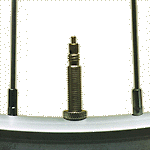
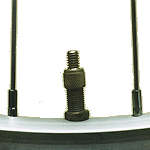
- Standard automotive-style air valve. The other, skinny kind is called "Presta".
There is a third type of valve, very rarely seen in the U.S., which has a bottom similar to a Schrader and necks down to about the size of a Presta. This is a Woods valve, formerly popular in the British Isles and Asia.
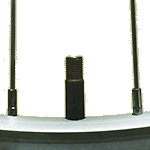
If you want to convert a rim drilled for Presta valves to accept Schrader valves, drill it out with a 21/64" drill bit.
The external threaded part of a Schrader valve is 7.7 mm (.302") x 32 T.P.I.
-
- A colloquial term for free samples of parts, clothing, etc. provided to bike shop employees, usually at manufacturers clinics or trade shows.
This term probably originated as a comical mispronounciation of "swag."
-
- A fast, reckless cyclist who scares horses and old folks. This is a term current in the late 19th century.
- In the early 1990s, Ibis made a small run of retro-style fixed-gear bikes for street use, which they called the "Scorcher." This was picked up by the media and casued a brief boomlet. The result is the use of the term "scorcher" to refer to a fixed-gear bike with cruiser-type flat curved handlebars, often without brakes.
-
- A fastener with male threads, usually with a slotted or recessed head. Strictly speaking, it's only a screw if the threads extend the full length of the shaft.
If the threads do not extend full length, technically it is a "bolt" but only pedants insist on this distinction.
-
- A "sealed" bearing is one which has rubber or plastic gaskets to prevent the entry of dirt. In the bicycle industry, the term "sealed bearing" is often used colloquially to refer to a cartridge bearing. This can be confusing to a consumer who may think that a hub is a high-tech cartridge-bearing unit, when it is actually a normal cup-and-cone bearing with a plastic dust cap.
-
- The chair-like fitting the rider of a recumbent sits on; also a device for carrying small children on a bicycle. See also "saddle."
-
- The junction between the seat tube, the top tube and the seat stays of a frame. The seat cluster usually also incorporates the seat-post binder bolt that clamps the seat tube or seat lug tight around the seat post to secure it.
-
- Metal tubing used in bicycle frames can be manufactured in two different ways:
Seamless tubing begins as a solid round bar, which is heated to a workable temperature, then pierced by a mandrel. It goes through a series of rolling operations to bring the diameter and wall thickness to the desired sizes.
- Seamed tubing begins as a strip of flat sheet metal, which is curled into a tubular shape, then the edges are welded together. After ths, the seamed tubing may also go through various rolling steps. Seamed tubing is cheaper, but weaker than seamless tubing. Generally all better quality bicycle frames are made from seamless tubing.
-
- The lug at the seat cluster of a lugged frame.
-
- British term for seat post, particularly the simple "pipe" type seat post which uses a separate saddle clamp.
-
- British term for seat post
-
- The tubular support that holds the saddle. The seat post telescopes into the seat tube of the frame, providing the adjustment for saddle height. It is usually secured by a pinch bolt at the top of th seat tube.
Older seat posts, and those on cheap bicycles, are basically pieces of pipe, perhaps with a different diameter (usually 7/8" / 22.2 mm) at the top end. A separate clamp attaches the saddle to this type of seatpost.
Modern, high-quality seat posts have the saddle clamp mechanism built into the top of the post. This type is also commonly referred to as "microadjusting" because it permits a finer degree of adjustment of the saddle angle.
Seat posts come in a wide range of diameters, from 21.15 mm to 31.8 mm. Low end department-store bicycles are typically 21.15 mm (13/16"). Most bicycles with one-piece cranks, including most BMX machines use this size. Bicycles with standard-size (1 1/8" / 28.6 mm o.d.) seat tubes usually use sizes between 25.4 (1") and 27.2 (1.07"). They typically come in sizes with even-numbered tenths of millimeters (26.0, 26.2, 26.4...).
For standard-sized seat tubes, the larger the seat post the thinner the tube. Thus, a larger seat-post size is often an indicator of a lighter, fancier frame.
I have a Database of Seat Post Sizes for various bicycles available on this site.
More information on seatposts is available in my article on Saddles.
-
- The binder bolt that secures the seatpost in the frame. It may be a conventional bolt with a nut, or an Allen bolt, or a quick release.
-
- Seat post
-
- An adaptor to allow a saddle with four frame rails to mount onto a standard one-bolt "microadjust" type seat post.
This consists of a grooved brass plate which fits between the upper and lower rails, so that the vertical clamp bolt doesn't distort them by squeezing them together. This accessory includes a longer than normal bolt, and is primarily used for mounting wider Brooks leather saddles, such as the B-72 and B-66.
-
- The thin frame tubes that run from the rear fork ends up to the seat cluster.
-
- The frame tube running from the bottom bracket up to the seat cluster.
-
- Selecta was an early Shimano ® attempt at a splined crank/bottom bracket system, dating from the late '70s or early '80s.
The spline pattern was chosen to permit the spindle to fit through a Front-Freewheel
bearing set, which wouldn't permit a standard sized square tapered bottom bracket spindle to fit throgh the front freewheel bearing assembly.
These turned out to be rather unreliable, due to the small diameter of the splines, and Shimano abandoned the system. The did continue to supply spare parts for many years thereafter, but these are no longer available.
See the 1982 Shimano Catalogue on this site.
-
- Self-energizing brakes use some of the braking force to provide a "power assist" to the brakes. The best-known self-energizing brake is the Scott-Peterson (Sun Tour)cantilever, which has a steep helical thread as its pivot, so that the forward force exerted by the rim against the pads helps cause the pads to press harder than they would from hand effort alone.
Self-energizing brakes are quite controversial, because they can have a non-linear response, which may lead to wheel lock-up.
-
- "Selle" is Italian for "saddles." It is the plural of "sella," saddle.
There are several Italian saddle makers whose corporate name begins with "Selle", including Selle Italia, Selle Royal, Selle San Marco and others. Sometimes people try to shorten these names and talk of a "Selle saddle", which actually makes no sense.
-
- The most common spoke pattern, used on the vast majority of bicycles. See my wheelbuilding article.
-
- Equipped with serrations ("teeth") to improve grip.****
Cone locknuts, washers, jaws of vise grips, pliers, pipe wrenches, saddle clamps.
-
- Italian for "silk". The finest tubular tires are made of silk fabric.
-
- A screw or bolt threaded into a ring or collar, designed to press against the shaft that the collar surrounds, so that the ring is held solidly against the shaft.
Rings with set screws are used to hold some cartridge bearing hubs and bottom bracket assemblies together.
Some tandem eccentric bottom brackets use set screws to hold the eccentric in position. A very few (mostly antique) bicycles also use set screws to secure the seatpost in the frame.
-
- A dimension sometimes used in specifying European frames. This is the horizontal distance from the seat tube/top tube intersection to a point directly above the bottom bracket. It is sometimes used as an alternate measurement to the seat tube angle.
- The offset of the clamping parts of a seatpost behind the center line of the seatpost.
-
- Tubular tire.
-
- Small flange (hub)
-
- Superglide ®
-
- An alternative drive system, replacing the chain and sprockets with right-angle bevel gears and a shaft running inside the right hand "chainstay."
Shaft drive was briefly popular around 1900, and occasional attempts are made to revive the design. Unfortunately, shaft drive turns out to have more problems than advantages.
A shaft drive requres heavier frame construction around the bevel gears to maintain their precise alignment under load. The drive system is heavier and less efficient than a good chain drive.
For reasons of clearance, the bevel gears of a shaft drive bicycle must be considerably smaller than the typical sprockets used with a chain drive. The smaller size of the gears causes an increase in the stresses on the whole support system for the shaft. This problem is exacerbated by the fact that the stresses from the shaft drive are not well resisted by the triangulated structure of a bicycle frame, because the stresses are perpendicular to the triangle.
Most of the advantages touted by proponents of shaft drive are only advantages compared with open-chain, derailer gear systems. Many proponents of shaft drive use specious (if not dishonest) arguments "comparing" shaft drive systems with derailer gear systems. Any such comparisons are meaningless, it's like comparing apples and locomotives.
A valid comparison of shaft vs. chain drives can only be made if both bikes use the same type of gearing, whether singles-speed or with an internal gear system.
These same advantages can be obtained with chain drive using a fully-enclosing chain case, as with old English roadsters and many current Dutch bikes.
Shaft drive proponents also often compare sealed, enclosed shaft drive systems with open, exposed chain drive systems. This is also a misleading comparison. All of the advantages claimed for shaft drive can be realized by the use of a chain case.
-
- Shimano trademark for a chainstay
protector with a projection near the front that was intended to keep the chain from getting jammed up if it overshifted the small chainring. This projection was triangular and resembled a shark's dorsal fin, hence the name.
This product was made of black plastic, with a peel & stick backing and a zip tieto hold it to the chainstay.
-
- During the late '80s when there was a fad for mounting U-brakes
under the chainstays. Shimano's Shark Tooth was a small plastic part that mounted to the right hand U-brake boss as an anti-chainsuck
device.
-
- The hand control for a gear shifting system. I used to object to this term, because it is actually the derailer or the internal hub that does the real shifting, and the part commonly called the "shifter" is only the control mechanism. I preferred the term "shift lever".
Since the increased popularity of twist-grip type controls, which are not levers, I have reluctantly come to accept the common usage of the term "shifter" to refer to the hand control.
-
- The leading manufacturer of bicycle parts. Shimano has come to dominate the industry, and to have a near monopoly on many parts categories. This gets them a lot of bad press, because they are perceived as the Goliath of the industry.
They achieved this position because they have the most successful research and development program in the industry. They pioneered many key technologies:
- Indexed shifting
Shimano was not the first to develop indexing, but Shimano's Positron and S.I.S. were the first practical systems that achieved commercial success.
- Cassette freehubs
Shimano was not the first with a cassette hub, but they did pioneer the placement of the right-side axle bearing outboard of the freewheel mechanism, which virtually eliminated the problem of bent axles, and made possible reliable hubs with 8- and 9-sprocket clusters.
- Hyperglide and Interactive Glide clusters
These developments did more to improve rear shifting than any change in derailer design.
- Superglide chainwheels
A similar system for front shifting.
- Biopace chainheels
A special shape for chainwheels which reduces knee stress and offers other benefits to some cyclists.
- SLR brakes
Which have reduced frictional losses and a lighter action than previous designs.
- SPD pedals
- STI shifting
Unfortunately, their pursuit of high performance has been somewhat at the expense of versatility. For example, to reap the benefits of Hyperglide or Superglide, you need to use one of the specific combinations of sprocket sizes designed to work together. While Shimano offers a pretty good selection, they don't have the perfect combination for every rider.
Shimano Date Codes:
Many Shimano parts feature a two-letter date code, indicating the year and month of manufacture:
Year Letter | Year | Month Letter | Month |
| A | 1976 | 2002 | A | January |
|---|
| B | 1977 | 2003 | B | February |
|---|
| C | 1978 | 2004 | C | March |
|---|
| D | 1979 | 2005 | D | April |
|---|
| E | 1980 | | E | May |
|---|
| F | 1981 | | F | June |
|---|
| G | 1982 | | G | July |
|---|
| H | 1983 | | H | August |
|---|
| I | 1984 | | I | September |
|---|
| J | 1985 | | J | October |
|---|
| K | 1986 | | K | November |
|---|
| L | 1987 | | L | December |
|---|
| M | 1988 |
|---|
| N | 1989 |
|---|
| O | 1990 |
|---|
| P | 1991 |
|---|
| Q | 1992 |
|---|
| R | 1993 |
|---|
| S | 1994 |
|---|
| T | 1995 |
|---|
| U | 1996 |
|---|
| V | 1997 |
|---|
| W | 1998 |
|---|
| X | 1999 |
|---|
| Y | 2000 |
|---|
| Z | 2001 |
|---|
More information on specific Shimano models and technologies is on a separate Shimano Page.
-
- Shimmy is a term for a harmonic shaking of the bicyle, which usually occurs at a fairly high speed. Shimmy can be very scary, and can lead to loss of control.
All bicycles are subject to shimmy under the right (wrong) cirucmstances, but it is more pronounced in some than in others.
The rider feels shimmy mainly through the handlebars, so it is often assumed that the cause relates to the front wheel or the headset. This is most often an illusion.
When shimmy is related to faulty equipment, it is more often the rear wheel that is at fault, especially if the spokes are too loose.
Serious shimmy is also freequently caused by floppy, poorly supported luggage on top of a rear luggage rack.
Jobst Brandt has his own take on Shimmy, read it here.
-
- A brake caliper that has the cable running down along the side. Both cable arms are on the same side of the caliper, one being pulled by the inner cable, the other being pushed by the cable housing.
- Single-pivot side-pull brakes have both arms pivoted on a central point, usually the same bolt that holds the caliper unit to the frame of fork.
- Dual-pivot side-pull brakes have a separate pivot for each arm. Dual-pivot brakes usually have more mechanical advantage than single-pivot units, but they don't track out-of-true or irregular rims as smoothly as single-pivot units.
- V-brakes are technically side-pull designs also, but this term is not normally used for them, since they are a type of cantilever, not caliper brake.
-
- Shimano's term for a roller clutch
-
- The finest tubular tires are made of silk fabric. Sometimes the term "silk" is used as a noun to refer to such tubulars.
-
- Defunct French component manufacturer, one of the earliest makers of derailers. They are best known in the U.S. for the cheap plastic derailers supplied on millions of Bike Boom ten speeds.
Simplex also made a "retrofriction
" down-tube shift lever that is considered by many to be the finest pre-index shift lever ever.
See also my page on French bicycles.
-
- Many newer drop handlebars have an indented groove or grooves in the curved section above the brake levers.
- Single-groove handlebars have such a groove along the front edge only, to accommodate the brake cable running from a modern "æro" brake lever.
- Double-groove handlebars have, in addition, a groove on the rear edge of the bar, to accommodate the shift cables from Campagnolo (or Sachs) Ergo shifters. If a double-groove handlebar is used without Ergo shifters, it is a good idea to tape a short length of housing into the groove, or to use a special rubber filler piece made for the purpose.
-
- The traditional type of side-pull brake caliper The same bolt that holds the caliper to the frame acts as the pivot for the brake arms.
-
- While any bike that doesn't have multiple gears is technically a "single speed" bike, current use of the joined word "singlespeed" generally refers to a bike with a one-speed freewheel
and hand brakes, distinct from both one-speed cruisers (these have coaster brakes, not freewheels) and fixed-gear machines.
See my Article on Singlespeed Mountain Bikes
(As far as I know, I was the first to deliberately remove the multiple-speed gearing from a mountain bike to make it simpler, lighter and more reliable...if I do say so myself!)
-
- A trail, such as a hiking trail, consisting of a single rut or path; this is as distinct from double-track, which refers to dirt roads or other routes made by and accessible to four-wheel vehicles.
-
- An obsolete type of tubeless tire. Similar to a tubular, but made like a loop of garden hose. They were held on to wooden rims by shellac. This type of tire was obsolete by the end of the 1920's. The most common size was 28 x 1 1/2.
The rim diameter is about the same as standard tubulars
, though few tubulars are as wide as the typical single tube. Reportedly, however, tubulars can be mounted on singletube rims. I haven't actually tried it, can't guarantee that it will work.
-
-
- Siping is the use of narrow grooves in the tread of a tire. The purpose of this is to allow water to escape instead of being trapped between the tire and the road, causing "hydroplaning."
Bicycle tires have such a small contact patch and run at such high pressures that hydroplaning is an imaginary problem, even with completely slick tires.
-
- Shimano Indexing System ®.
-
- In a quick-release hub, the skewer is the shaft that runs through the middle of the hollow axle, and the associated hardware, in cluding the quick-release cam and the acorn nut.
A rod used to help maintain alignment in a stack of elastomer bumpers in an elastomer suspension fork.
-
- A fairly long style of bar end, with a bend halfway along it causing the front part to bend inward and a bit upward.
-
- Fixed-gear riders who make a habit of doing "skip stops" you will wear the rear tire out considerably faster than those who use a brake. This problem is exacerbated by certain gear ratios, because they may tend to repeatedly skid on the same section of the tire.
Riders who plan to do a lot of skip stops should consider the ratio when selecting their chainring and rear sprocket. The mathematics of this is actually fairly simple:
- Simplify the gear ratio to the smallest equivalent whole number ratio.
- The denominator of the resulting fraction is the number of skid patches you will have on your rear tire.
Examples:
44/16 simplifies to 11/4, so there would be 4 skid patches.
45/15 simplifies to 3/1 so there would only be 1 skid patch.
42/15 simplifies to 14/5, so there would be 5 skid patches.
43/15 can't be further simplified, so there would be 15 skid patches.
This is based on the assumption that you always skid with the same foot forward. If you are an ambidextrous skidder, and the calculation gives an even result, your number of skid patches will be the same.
If you are an ambidextrous skidder, and have an odd denominator, the number of possible skid patches will be doubled.
-
- A tire in which the cord of the sidewalls is only covered with a very thin coat of rubber, if any. This makes the tire more flexible, for lower rolling resistance, but the sidewalls are more easily damaged than those of blackwalls or gumwalls.
-
- Older style of chain, with 1" pitch. This type of chain has the same number of rollers as a similar length of normal 1/2" pitch chain, but they are spaced alternately close together and far apart. Every other roller engages a sprocket tooth. This type of chain was in common use up until around World War Two. See also block chain.

An 8-tooth sproket for 1" pitch "skip link" chain (left) is equivalent to a 16 for standard 1/2" chain.
Skip Stop
- Fixed-gear riders generally need to master a technique called the "skip stop." This is a way that you can actually lock up the rear wheel using your legs alone.
- If you lock one leg at the bottom of the pedal stroke, as the pedal rises it will start to lift your body upward.
- When the cranks get horizontal, pull up on the front pedal, while pushing down on the rear one.
- Because your body will have acquired upward momentum, when you yank up with the front foot this will temporarily partially unweight the rear wheel, making it possible to initiate a skid.
Since sliding friction is less than sticking friction, once the tire starts to skid, you will generally be able to maintain the skid until you've stopped or at least slowed down as much as you want to.
You have to really want to do it, you can't be tentative! It's easier when you're going faster.
The lower your gear
, the more effectively you can "brake" by resisting with your legs.
Despite what some folks will tell you, you can not stop nearly as short this way as you can by using a good front brake.
See my article on Braking and Turning
for a detailed explanation of this.
-
- "Slick" or "bald" tires, those with no tread pattern, or perhaps just a bit of siping, provide the best performance for bicycles which are used on pavement.
Slick tires are smooth and silent running, and have excellent traction. They have the lowest rolling resistance of all tire styles. Many people reject them because they look slippery, but in practice, they are not. Tread patterns on road tires are purely cosmetic, and have no practical value on hard paved surfaces.
-
- Shimano Linear Response, a series of friction-reducing modifications introduced in the late 1980's in the Shimano 105 group. The 105 SLR brakes (the best sidepull calipers ever made, in my opinion) incorporated:
- Ball bearing caliper pivots.
- Low-friction cables.
- Nylon spring bumpers.
- Reduced spring tension.
By adding a weak return spring to the brake lever, they were able to drastically reduce the tension of the caliper return spring. Since the cable was being pushed at one end and pulled at the other, a positive return function could be attained with a much lower overall spring tension. This greatly improved the "feel" and sensitivity of the brake. (This aspect of the SLR design was, I believe, copied from Dia Compe, which calls it "B.R.S.".)
This system was replaced by "Super SLR" which is Shimano's name for double-pivot brakes.
Snake Bite
- A colloquial term for a pinch flat, or rim cut taken from the resemblance between the pair of holes in the tube and the puncture wound made by the fangs of a snake.
-
- A novelty spoke pattern in which the spokes wrap around one another where they cross.
-
- A rare type of bicycle for two riders sitting side-by-side. Not technically a "tandem" since that term implies one rider in front of the other.
-
- A plain hub axle, as opposed to a quick-release axle, which has a hole drilled through it for the quick-release skewer. A solid axle is secured to the frame by nuts.
-
- A bicycle for one rider, as opposed to a tandem; a normal bicycle.