
shimano,bicycle,sheldon,brown,shimano,dura,ace shimano,ultegra,shimano,xtr,deore,xt,deore,lx,600,105sc,rx100,shimano,rsx,freehub nexus,shimano,hyperglide,sis,sti,rapidfire,cartridge,hyperdrive,cantilever,shimano headset,exfire,shimano,index,system,parallax,spd,shimano,pedal,pedaling ,dynamics cassette,internal,hub,bicycle
Accessories Bicycles Parts Specials Tools

sheldonbrown.com sheldonbrown.net sheldonbrown.org WWW
Sheldon Brown photo

Sheldon Brown's Shimano Page

This page is at an early "under-construction" stage,
but I am putting it up early because other pages link to it.

See also Shimano's Corporate Page.

Spoke Divider

Brakes (Caliper) | Brakes (Cantilever) | Brakes (Hub) | Cassettes | Chains | Cleats | Date Codes | Derailers (Rear) | Derailers (Front) | Freehubs | Freewheels | Pedals | Shifters

Buzzwords:

Biopace | Dyna Dive | EZ Fire | FFS | Freehub | GS | Hyperglide | Hyperdrive C | Nexave | Nexus | Octalink | Parallax | Positron | Power Modulator | RapidFire (RF) | RapidFire Plus (RF+) | RapidRise | Servo Wave | SIS | SPD | SLR | STI | Uniglide | V Brake

Model Names:

Crane | Dura-Ace | Eagle | Exage | Hone | | Lark | Light Action | Santé | Selecta | Titlist | Ultegra

Spoke Divider
Shimano is the leading manufacturer of bicycle parts. Shimano has come to dominate the industry, and to have a near monopoly on many parts categories. This gets them a lot of bad press, because they are perceived as the Goliath of the industry.

They achieved this position because they have the most successful research and development program in the industry. They pioneered many key technologies:

Unfortunately, their pursuit of high performance has been somewhat at the expense of versatility. For example, to reap the benefits of Hyperglide or Superglide, you need to use one of the specific combinations of sprocket sizes designed to work together. While Shimano offers a pretty good selection, they don't have the perfect combination for every rider.

Pedals/Cleats

SPD Pedal/Cleat Interchangeability
M858M747M636M545M535M515M434M737M525A525M32374106500SPD-R
SM-SH70 (No Float )okokokokokoknonononoyesyesno
SM-SH71 (With Float)okokokokokoknonookokyesyesno
SM-SH50, 51 "Single-release"noyesyesyesyesyesyesyesyesyesyesnonono
SM-SH52 "Single-releaseyesyesyesyesyesyesyesyesyesyesyesnonono
SM-SH55 "Multi-releaseyesyesyesyesyesyesyesyesyesyesyesnonono
SM-SH56 "Multi-releaseFor PD-M959, PD-M540 & PD-M520 pedals.
SM-SH90 SPD-R (No Float )nononononononononononononoyes
SM-SH91 SPD-R (With Float )nononononononononononononoyes
Table courtesy Eric Salathé

Shimano Groups

Shimano markets most of their parts as "groups". A group would usually consist of at least a set of hubs, derailers and controls, a crankset and brakeset, all with the same group model name. High end groups often include additional parts, including: headsets, seatposts, pedals, chains, cassettes.

Shimano has many trademarks for different quality levels and technological features/gimmicks.******

1997 Shimano Road Group Heirarchy

  1. Dura Ace
    9-speed
  2. Ultegra
  3. 105SC
  4. RX-100
  5. RSX

1997 Shimano Mountain Group Heirarchy

  1. XTR
    Ti, Differential Plate Mechanism, hollow cranks
  2. Deore XT
    Parallelogram V-Brakes
  3. Deore LX
  4. STX-RC
  5. STX
  6. Alivio
  7. Acera-X
  8. Altus
  9. Tourney

Other 1997 Groups

Older Group Names

Correspondences between older groups and current groups are only approximate. These data are incomplete. Shimano has gone through many revisions of their groups while maintaining the same name, so comparisions between older versions and newer versions are quite inexact.
1056-speed version, became 105SC when 7-speed and dual-pivot brakes were added.
200GSReplaced by Altus
300GSReplaced by Acera-X
400GSReplaced by Alivio
500GSReplaced by STX
600Became 600EX when indexing was introduced, 600 Ultegra (Gray finish) when 7-speed added. When it became an 8-speed group, the 600 designation still existed, but it was usually referred to as just "Ultegra". With the '98 model year, 9-speeds came in and the "600" designation was completely dropped from Ultegra.
DeoreOriginally an early '80's touring group, designed so that almost all adjustments could be made with a single 6 mm Allen wrench. Evolved into Deore XT MTB group, DX and LX spun off later.
Deore DXDiscontinued designation, replaced by LX
Exage("EXcellence" + "New AGE") This was divided into Exage Country and Exage Trail at one time. The first group to feature front indexing, roughly comparable to Acera-X/Alivio.
Ultegra ("ULTimate" + "IntEGRity") is the second highest level "road" group. The Ultegra name was added as a suffix to 600 when 7-speeds (and the gray paint finish) came in in the early '90s. For the 1998 model year, Ultegra became a 9-speed group, and the 600 designation was retired.

Shimano Buzzwords and Trademarks

333 ®

An older model, rather unsatisfactory 3-speed hub.

See: http://sheldonbrown.com/333

Biopace ®

A type of non-round chainwheel introduced by Shimano in the 1980's. It is designed to provide a more natural motion of the foot, better off-road traction, and to reduce stress on the knee.

See my article on Biopace for more details.

Crane ®

Top-of-the-line touring derailer of the 1970's.

Dura-Ace ®

The jewel in Shimano's crown, the flagship road racing group.

There are interchangeability issues with older Dura-Ace parts, and I have an article on Dura-Ace interchangeability. See also the 1973 Shimano Dura-Ace Catalogue on this site.

Dyna Drive ®

In the early '80's, Shimano introduced a special crank/pedal set, which used much larger diameter threading where the pedal screwed into the crank. This allowed them to build the bearing into the inside of the pedal thread, eliminating the need for a pedal axle. The purpose of this was to improve the biomechanics of the pedal by placing the bottom of the foot below the pedal axis.

This was rather a good idea biomechanically, but never caught on. In practice, the pedal bearings turned out to be underengineered for the loadings they had to deal with.

See the 1982 Shimano Catalogue on this site.

Eagle ®

A beefed up version of the Lark , including an extra thick mounting claw and a built in bumper to protect the derailer from impact. Probably the strongest derailer ever made before the 21st century models such as Saint and Hone

Exage ®

"EXcelence + "new AGE"

EZ-Fire ®

EZ-Fire Plus ®

Front-Freewheel System (FFS ®)

Front Freewheel System. The freewheel was built into the bottom bracket, so that the chain would turn even when the rider was coasting. This was to allow shifting while coasting--a solution in search of a problem.

See the 1982 Shimano Catalogue on this site.

Freehub ®

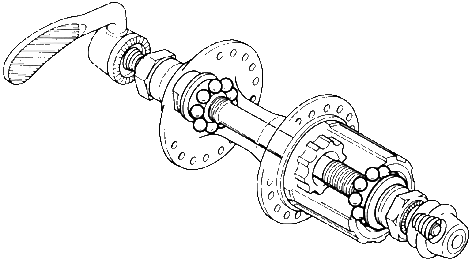
A rear hub in which the freewheel mechanism is built into the hub itself, rather than being part of the sprocket cluster. Most freehubs use a cassette of sprockets.

Shimano's patented design places the right cone much closer to the end of the axle than does a conventional hub, greatly reducing the chance of bending or breaking axles. For more detail see my article on Shimano Cassettes.
GS

Hone

Heavy-duty "downhill " component set  

HG (Hyperglide ®)

Hyperglide ®  

Hyperdrive-C ®

Shimano's name for Compact Drive. See the Shimano Cassette Freehub page for details.

IG ®

Interactive Glide. See the Shimano Cassette Freehub page for details.  

Lark ®

-preselector
 

Light Action ®


Low Flex ® Cantilever


Nexave ®


Nexus ®


Octalink ®

Octalink Glossary Entry  

Parallax ®

This term refers to hub shells with a larger diameter barrel, generally marketed as "mountain bike" parts. Primarily a cosmetic issue.  

Positron ®

This was Shimano's first attempt at indexed shifting. The indexing "clicks" were built into the derailer, not the lever. The positron system didn't have a return spring; some models used a double cable to pull the derailer back and forth; other models used a single, semi-rigid push-pull cable.

Positron was a valuable learning experience for Shimano. Their original theory was that experienced cyclists already knew how to shift, but that beginners could benefit from a system that didn't require fine-tuning of the shift lever position. For this reason, Positron was offered on entry-level bikes, often department-store models. This marketing theory turned out to be unworkable. The parts had to be made very cheaply to meet the price points required. This caused less-than-impressive performance. In addition, the fact that Positron was only supplied on bottom-end bikes caused it to acquire a poor connontation, as something to be outgrown, and not to be considered by a "serious cyclists."

Shimano went back to the drawing board, and the next time they tried indexed shifting, in 1984, they started at the top of the line, with Dura-Ace S.I.S. Cyclists were initially dubious about this feature, but it worked so well that most resistance was overcome. Once the pros started using it, this now-glamorous feature rapidly trickled down to the hoi polloi. The result was Shimano's complete domination of the bicycle parts market, much as Microsoft dominates the computer software market. By 1986 it had become almost impossible to sell a bike that didn't have indexed shifting.

See the 1982 Shimano Catalogue on this site.

Many Positron-equipped bikes also featured the Front Freewheel System, but this was not a specific linkage...either of these systems could and did function without the other.  

Power Modulator ®

As bicycle brakes have improved in recent years, there has arisen the perception that some front brakes are "too good" as if such a thing was possible.

As a result, some manufacturers have taken to adding devices that deliberately sabotage the functionality of the front brake, out of fear that an unskilled rider will take a header as a result of improper use of the front brake.

These sabotage devices are commonly called "power modulators" and sometimes are marketed as if they were a version of ABS braking as used on newer cars.

This is a very foolish approach, probably driven by the common superstition that the use of the front brake is inherently dangerous. The result is increased stopping distance. This is a "safety" feature that is actually more likely to be a detriment to safety.

See also my article on Braking and Turning  

RF ®

RapidFire ® Shimano's first "below the bar" shifting system, early '90s. It used two buttons operated by the rider's thumb, one for upshifting, one for downshifting. This caused confusion since the ushifting and downshifting motion was done with the same digit, in the same direction.  

RF+ ®

RapidFire Plus ® Successor to RapidFire, used a thumb button to select a larger sprocket/chainring, and an index-finger "trigger" to select a smaller one. This solved the ergonomic problems of the original RapidFire, and remains Shimano's flagship shifting system for upright handlebars.  

RapidRise ®

This is Shimano's trademark for "low-normal" rear derailers.

Santé

Saint

Heavy-duty "downhill " component set

Selecta ®

Selecta was an early Shimano ® attempt at a splined crank/bottom bracket system, dating from the late '70s or early '80s.

The spline pattern was chosen to premit the spindle to fit through a Front-Freewheel bearing set, which wouldn't permit a standard sized square tapered BB spindle to fit throgh the front freewheel bearing assembly.

These turned out to be rather unreliable, due to the small diameter of the splines, and Shimano abandoned the system. The did continue to supply spare parts for many years thereafter, but these are no longer available.  

Servo Wave ®

Brake lever with variable mechanical advantage. Low MA at the beginning of the stroke brings the shoes to the rim quickly, higher MA later in the stroke provides more braking power.  

SIS ®

Shimano Indexing System ® Shimano's brand of indexed shifting.  

SLR ®

Shimano Linear Response ® A constellation of brake improvements primarily aimed at reducing friction. Includes the use of lined cable housing and lightly sprung calipers/cantilevers, accompanied by levers that also contain a return spring (a Dia Compe invention.) SLR was introduced with the 105 group in the late '80s.  

SPD ®

Shimano Pedaling Dynamics. First commercially successful clipless shoe/pedal system with a recessed cleat for walkability. (Cyclebinding was an earlier walkable system that never caught on.)  

Super Plate ®

Ultra-wide range non-indexing derailer, notoriously fragile. Similar to the Hurét Duopar. Early-mid '80's  

STI ®

System Total Integration ® Originally referred to any combined brake/shift lever assembly, but in current usage, this term generally refers only to drop-handlebar brifters.

Super SLR ®


Titlist ®

Inexpensive steel front derailer of the '70's  

Ultegra ®

"ULtimate inTEGRity"  

Uniglide ®

Older Shimano freewheel and cassette sprocket design, using twisted teeth for improved shifting. Uniglide cassettes used a single threaded sprocket as a lockring to hold the larger sprockets to the Freehub body. Uniglide was superceded by Hyperglide in the late 1980s.  

V-Brake ®

 
Year
Letter
YearMonth
Letter
Month
A19762002AJanuary
B19772003BFebruary
C19782004CMarch
D19792005DApril
E1980EMay
F1981FJune
G1982GJuly
H1983HAugust
I1984ISeptember
J1985JOctober
K1986KNovember
L1987LDecember
M1988
N1989
O1990
P1991
Q1992
R1993
S1994
T1995
U1996
V1997
W1998
X1999
Y2000
Z2001

See also the 1982 Shimano Catalogue on this site.

See also the 1973 Shimano Dura-Ace Catalogue on this site.

Articles by Sheldon Brown and others
Harris
Home
Beginners Brakes Commuting
Lights
Cycle-
Computers
Do-It-
Yourself
Essays
Family
Cycling
Fixed Gear
Singlespeed
Frames Gears &
Drivetrain
Bicycle
Humor
Bicycle
Glossary
Bicycle
Links
Old
Bikes
Repair
Tips
Tandems Touring What's
New
Wheels Sheldon
Brown

Accessories Bicycles Parts Specials Tools

Feedback? Questions?

Copyright © 1996, 2008 Sheldon Brown

Back to Harris Cyclery Home Page

If you would like to make a link or bookmark to this page, the URL is:
http://sheldonbrown.com/shimano.html

