Bicycle Tires and Tubes

|




|
|

Many people suppose that tires are made out of rubber, because that's what is visible. This is a major oversimplification -- rubber is the least important of the three components that make up a tire:
The fabric threads don't interweave with crossing threads as with normal cloth, but are arranged in layers or "plies" of parallel threads. Each layer runs perpendicular to the next layer(s).
Some tires use thick thread, some use thin thread for the fabric. With thin thread, there are more threads per inch ("TPI") and this number is often considered an important indication of tire performance.
The higher the TPI number, the thinner and more flexible the tire fabric is. Thin-wall (high TPI) tires tend to be lighter and have lower rolling resistance, but they're more easily damaged by road hazards.
Bicycle tires have the threads of the fabric running diagonally, ("bias") from bead to bead. Modern car tires have the main threads running straight over from one bead to the other, known as "radial" construction. Radial tires will also have a "belt" of plies running all the way around the circumference of the tire, crossing the radial plies.
Radial tires have been tried for bicycles, but they tend to be too floppy from side to side. This floppiness feels quite unpleasant in actual riding--much like the feel of a grossly underinflated tire.
Some bicycle tires also have a Kevlar ® belt running under the tread area, in addition to the normal bias plies. This is intended as a puncture preventive.
The rubber that comes into contact with the ground is called the "tread." This area usually has thicker rubber than the "sidewalls" of the tire, mainly for wear resistance. Most tires have some sort of 3-dimensional pattern molded into the tread, which may or may not enhance traction.
Manufacturers mix different additives with the rubber to achieve desired traction/wear characteristics. Generally, a softer formulation will give better traction, but at the expense of more rapid wear. Rubber is normally a sort of tan color, but most tires are black. This is the result of adding carbon black to the mix. Carbon black considerably improves the durability and traction of the rubber in the tread area.
Some manufacturers substitute a silicon compound for the carbon black. These tires usually have a gray tread. Whether silicon or carbon black provides better traction is subject to dispute. Gray-tread tires are preferred for indoor use (for example, on wheelchairs), because they do not leave black marks on floors.
"Dual-compound" tires feature a center strip of fairly hard rubber for improved wear, with a softer, grippier formulation toward the sides of the tread. The intent is to provide better cornering traction without compromising the lifespan of the tread.
Many bicycle tires are "gumwalls" or "skinwalls." Gumwall tires have tan sidewalls, with no carbon black. This may make the sidewalls slightly more flexible, reducing rolling resistance. It is not clear to what extent this makes a difference.
Skinwalls have either no rubber on the sidewalls, or a very thin layer. This, too is an attempt to make the sidewall more flexible and reduce rolling resistance.
Tubular tires, also known as "sew-ups" or "sprints" differ from clinchers in that they don't have beads. Instead, the two edges of the tire are sewn together around the inner tube. Tubulars are used on special rims, and are held on to the rims by glue.
Tubulars used to be fairly common on high-performance bicycles, but these days they are an endangered species.
| Tubular Pros: | Tubular Cons: |
|---|---|
|
|
| Valve Types: | ||
|---|---|---|
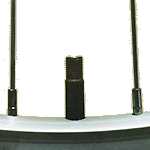 |
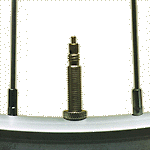 |
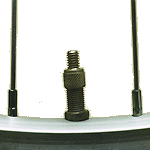 |
| Schrader valve | Presta valve | Woods/Dunlop valve |
Before World War II, tires and tubes were made from natural latex rubber, harvested from tropical trees. When the supply of natural latex was insecure during the war, a substitute, "butyl" was invented. Butyl turned out to be a very successful substitute, better, in fact, than latex for this application. All modern tires and most inner tubes use butyl rubber.
Some riders prefer latex inner tubes, because they can be a bit lighter than butyl ones. Some riders believe that latex tubes have less rolling resistance than butyl.
Latex tubes are commonly a bit more porous than butyl ones, and need to have their pressure topped off more often.
It is commonly thought that the air pressure in a tire supports the rim. If you think about it, this cannot be true, because the air pressure against the rim is equal, top and bottom. How, then, does a tire support its load?
First of all, the role of air pressure in the tire is to hold the fabric under tension -- in all but one place, the contact patch with the road surface.
Air pressure can't add tension at the contact patch, because the contact patch is flattened against the road. Air pressure can only push directly outward, and so here, it pushes directly downward. The downward force of the air must equal the weight load, and so the area of the contact patch approximately equals the weight load divided by the air pressure. (Edge effects and skewing of the weave of the fabric may result in some difference.) For example, if the air pressure is 50 PSI and the load is 100 pounds, the contact patch will be about two square inches.
The threads of the tire fabric can transmit loads only lengthwise and in tension. How then, do they transfer the load from the contact patch to the rim?
Because the contact patch is flat against the road, the curvature of the sidewalls next to it is increased, decreasing their tension, and the angle at which they approach the contact patch becomes shallower. These effects produce the bulge seen at the bottom of a tire under load and transfer the load from the contact patch to the tire sidewalls. The threads of the fabric are pulling downward less and outward more. The load is similarly transferred from the sidewalls to the rim. The sideways forces at the right and left side of the tire are equal and opposite, and cancel out.
With a bias-ply tire, the load is carried lengthwise in both directions along the tire by the diagonal threads, so the bulge is longer and less deep than on a radial-ply tire. In the early days of radial-ply car tires, people often thought they were underinflated, because the bulge at the bottom was more pronounced.
A tire, then, supports its load by reduction of downward pull, very much the same way that spoking of the wheel supports its load. The tension-spoked wheel and the pneumatic tire are two examples of what are called preloaded tensile structures, brilliant, counterintuitive designs working together remarkably to support as much as 100 times their own weight.
Bias plies also help to transmit lateral and torque loads, by triangulating the connection between the contact patch and the rim -- much like the way the spokes of a semi-tangent spoked wheel transmit lateral and torque loads. With tubulars, the diagonal plies also work like a Chinese finger puzzle: the air pressure makes the tire fatter, and so tries to make it shorter and helps hold it to the rim. Radial-ply tires for bicycles have been tried -- Panasonic made them for a short time in the 1980s -- but they proved to have an odd feel due to their reduced lateral stability.
If you would like to get into mathematical details, there is an excellent technical description in an old Britannica encyclopedia article online.
"Traction" refers to the tire's resistance to skidding/slipping. There are three areas where traction is at issue: braking, climbing, and cornering. Different tire designs, particularly in the tread, may enhance or degrade traction in each of these cases.
The traction of a tire is determined by three things: inflation pressure, rubber formulation, and tread pattern.
Traction is also influenced by the presence or absence of suspension, and by the rider's posture and technique (see also our article on Braking and Turning.)
Treads can help improve off-road traction in two ways:
Bicycle tires for on-road use have no need of any sort of tread features; in fact, the best road tires are perfectly smooth, with no tread at all!
Unfortunately, most people assume that a smooth tire will be slippery, so this type of tire is difficult to sell to unsophisticated cyclists. Most tire makers cater to this by putting a very fine pattern on their tires, mainly for cosmetic and marketing reasons. If you examine a section of asphalt or concrete, you'll see that the texture of the road itself is much "knobbier" than the tread features of a good-quality road tire. Since the tire is flexible, even a slick tire deforms as it comes into contact with the pavement, acquiring the shape of the pavement texture, only while in contact with the road.
People ask, "But don't slick tires get slippery on wet roads, or worse yet, wet metal features such as expansion joints, paint stripes, or railroad tracks?" The answer is, yes, they do. So do tires with tread. All tires are slippery in these conditions. Tread features make no improvement in this.
[Jobst Brandt advanced this point of view when he was involved with design of tires for Avocet. Jan Heine, of Bicycle Quarterly magazine, disagrees, saying that a light file tread pattern at the sides of the tread helps with traction when cornering on a wet surface .]
Car and truck tires need tread, because these vehicles are prone to a very dangerous condition called "hydroplaning." This happens when driving fast in very wet conditions, which can lead to the tire's riding up onto a cushion of liquid water. When this happens, there is a sudden and total lack of traction.
| Cars can hydroplane because: | Bicycles canNOT hydroplane because: |
|---|---|
| A car tire has a square road contact, and the leading edge of the contact is a straight line. This makes it easier for a car tire to trap water as it rolls. | A bicycle tire has a curved road contact. Since a bicycle leans in corners, it needs a tire with a rounded contact area, which tends to push the water away to either side. |
| A car tire is quite wide, so water from the middle of the contact patch can have trouble escaping as the tire rolls over it, if there are not grooves to let it escape. | A bicycle tire is narrower, so not as much water is in contact with the leading edge at once. |
| Car tires run at much lower pressure than bicycle tires. | The high pressure of bicycle tires is more efficient at squeezing the water out from under. |
| Cars go much faster than bicycles, again leaving less time for water to escape. | At high speeds, hydroplaning is just possible for car tires, but is absolutely impossible for bicycle tires. |
Even with automobiles, actual hydroplaning is very rare. It is a much more real problem for aircraft landing on wet runways. The aviation industry has studied this problem very carefully, and has come up with a general guideline as to when hydroplaning is a risk. The formula used in the aviation industry is:
Here's a table calculated from this formula:
| Tire Pressure | Hydroplane Speed Miles per hour |
Hydroplane Speed Kilometers per hour |
|
|---|---|---|---|
| P.S.I. | Bars | ||
| 120 | 8.3 | 113 | 183 |
| 100 | 6.9 | 104 | 167 |
| 80 | 5.5 | 93 | 149 |
| 60 | 4.1 | 80 | 129 |
| 40 | 2.8 | 66 | 105 |
Knobby treads actually give worse traction on hard surfaces! This is because the knobs can bend under side loads, while a smooth tread cannot.
The bending of knobs can cause discontinuities in handling: the tire grips OK for mild cornering, but as cornering force exceeds some critical value, the knobs start to bend and the traction suddenly goes to Hell in a handbasket.
Many tire makers market "combination-tread" tires, that are purported to work well on both pavement and dirt. Generally, they don't.
The usual design is to have a smooth ridge down the center of the tread, with knobs on the sides. The theory is that the ridge will provide a smooth ride on pavement, with the tire inflated fairly hard, and the knobs will come into play off-road, with the tire running at lower pressure (or sinking into a soft surface.) Another aspect of this design is that the knobs are intended to come into play as you lean into a turn.
In practice, combination-tread tires don't work all that well. They do OK in dirt, but they're pretty lousy on pavement. They're much heavier than street tires, and if you corner aggressively, the transition from the center strip to the knobs can cause sudden washout. They aren't quite as slow and buzzy as true dirt tires, but they're much worse in this respect than smoothies.
If you mostly ride on pavement, but also do a fair amount of dirt, a combination tire on the front may be a good choice for you, with a road tire on the back. See the section on mixing/matching tires.
There is a relatively new, international system of tire sizing which eliminates these confusions. This is explained in considerable detail on this site in the article on Tire Sizing.
There are four ways to reduce this friction, each subject to trade-offs:
The trade-off with this is that the thinner the tire gets, the more fragile it is, and the sooner it will wear out.
The trade-off with this is that if you pump the tire up too hard, you lose the benefits of pneumatic tires: the ride becomes excessively harsh, and traction will be reduced. In addition, extremely high pressures require a stronger (heavier) fabric and stronger (heavier) rim flanges.
When riding on a smooth surface, rolling resistance does decrease theoretically with any increase in pressure, but with modern, high-quality tires the rolling resistance at correct inflation pressure is already so low that the infinitesimal reductions gained are more than outweighed by the trade-offs.
In practice, riding surfaces aren't perfectly smooth, and overinflation actually increases rolling resistance, due to vibration.
Tire width and pressure are inextricably linked. It is a serious mistake to consider one independently of the other. Generally, wider tires call for lower pressures, narrower tires call for higher pressures.
Consider, for example, a tire one inch across, at a pressure of 100 PSI (pounds per square inch). Air is pushing down against the bottom half of the tyre cross-section with a force of 100 pounds per inch of length. Each sidewall of the tire bears half that load, and so each inch of length of tire sidewall will be under a tension of 50 pounds. Now let's consider a tire twice as wide, two inches across, at the same 100 PSI. Each inch of sidewall will be under a tension of 100 pounds. So, a wider a tire would ride harder, and need stronger fabric, if inflated to the same pressure,
The part of the tire that is actually touching the ground at any moment is called the "contact patch." Generally, the area of the contact patch will be directly proportional to the weight load on the tire, and inversely proportional to the inflation pressure. For instance, if the rear tire of a bike is supporting a load of 100 pounds, and the tire is inflated to 100 PSI (pounds per square inch) the contact area of the tire will be roughly one square inch. If the pressure is reduced to 50 PSI, the tire will squish out until the contact patch has become 2 square inches (or until the rim bottoms out against the tire.)
A common debate among cyclists centers on the issue of whether a wider tire has more or less rolling resistance at the same pressure. The constant pressure is proposed because it appears more scientific to eliminate this as a variable, but this is not realistic in practice. The short answer to this question is that, yes, a wider tire of similar construction will have lower rolling resistance than a narrower one at the same pressure. This fact is, however, of no practical value. If you are comparing two tires of similar construction, with the same load, and the same pressure, either the wider tire is overinflated, or the narrower tire is underinflated!
A tire is supposed to deflect a bit under load. This deflection the whole purpose of pneumatic tires. When you sit on your bike, your tires should visibly bulge out at least a bit under your weight. If they don't, they're overinflated.
| Underinflation | Correct Inflation | Overinflation |
|---|---|---|
|
|
|
Most tires have a "maximum" pressure, or a recommended pressure range marked on the side of the tire. These pressure ratings are established by the tire manufacturers after consultation with the legal and marketing departments.
The lawyers want the number kept conservatively low, in case the tire gets mounted on a defective or otherwise loose-fitting rim. They commonly shoot for half of the real blow-off pressure.
The marketing department wants the number high, because many tire purchasers make the (unreliable) assumption that the higher the pressure rating, the better the quality of the tire.
Newbies often take these arbitrary ratings as if they had some scientific basis. While you'll rarely get in trouble with this rote approach, you will usually not be getting the best possible performance.
Savvy cyclists experiment with different pressures, and often even vary the pressure for different surface conditions.
Optimal pressure for any given tire will depend on the load it is being asked to support. Thus, a heavier rider needs a higher pressure than a lighter rider, for identical tires.
Since most bicycles have substantially more weight on the rear wheel than on the front, the rear tire should almost always be inflated to a higher pressure than the front, typically by about 10%.
Rough surfaces generally call for a reduction in pressure to improve ride comfort and traction, but there is a risk of pinch flats if you go too far. Even at the lower appropriate pressure, wider tires, because they also are deeper, are more immune to pinch flats.
Rider skill also enters into this: more experienced cyclists learn to "get light" for a fraction of a second while going over rough patches; newbies tend to sit harder on the saddle, increasing the risk of pinch flats.
The table below is based on my experience and a certain amount of guesswork, and should only be used as a very rough guide to a starting point. Interpolate/extrapolate for your own weight/tire sizes.
Tire widths are in millimeters, pressure recommendations in pounds per square inch. (Divide by 15 if your gauge reads in bars/atmospheres.)
| Tire width in mm | |||||||
|---|---|---|---|---|---|---|---|
| Wheel load | 50 mm | 37 mm | 32 mm | 28 mm | 25 mm | 23 mm | 20 mm |
| 100 lbs/50 kg | 45 | 60 | 75 | 100 | 110 | 120 | 130 |
| 70 lbs/35 kg | 35 | 50 | 65 | 80 | 90 | 100 | 110 |
Note that these recommendations are based on the actual tire width. Many tires are marked wider than they actually are. See: "Dishonesty in Sizing."
Bicycle Quarterly Magazine has published an article recommending optimum pressures.
Please do not contact us with questions about specific tire pressure recommendations!
Trikes and two-wheel trailers are very different from bikes, because they don't lean in corners. Most tire wear comes from cornering forces. On a bike, these forces act on different parts of the tread, according to how far one leans into various corners at various speeds.
With a trailer or trike, all of the wear is concentrated on the middle of the tread. If you overinflate the tires, you'll be riding on only the very center of the tread, and it will wear rapidly.
In addition, wheel alignment is never going to be perfect. As a result, the paired tires will always "scrub" a bit. If the tires are rock-hard, this will cause rapid wear. If the tires are softer, they can flex slightly sideways to accommodate the scrub, without wearing the tread off.
With trailers, severe overinflation can also lead to flipping the trailer over, due to the tires' bouncing on road irregularities. The load on trailer wheels is often very light. Adjust pressure accordingly, and evaluate pressure by tire drop. You may want to lower pressure when the trailer is empty and raise it when carrying a load. This is one good reason to carry a pump, rather than using CO2 inflation cartridges, which are good for only one use each.
Competitive pressures have often led to inaccuracy in width measurement. Here's how it works: Suppose you are in the market for a high-performance 700 x 25 tire: you might reasonably investigate catalogues and advertisements to try to find the lightest 700-25 available. If the Pepsi Tire Company and the Coke Tire Company had tires of equal quality and technology, but the Pepsi 700-25 was actually a 700-24 marked as a 25, the Pepsi tire would be lighter than the accurately-marked Coke 700-25. This would put Pepsi at a competitive advantage. In self defense, Coke would retaliate by marketing an even lighter 700-23 labeled as a 700-25.
This scenario prevailed throughout the '70's and '80's. The situation got so out-of-hand that cooler heads have prevailed, and there is a strong (but not universal) trend toward accurate width measurements.
Most bikes come with identical tires front and rear. This is all right for general use, but if you want to optimize your bike, you should consider using different tires front and rear. The front and rear tires have different loadings and different requirements.
A wider tire also provides superior shock absorbency. I personally prefer a slightly wider tire in front, since I suffer from some wrist discomfort on occasion.
Bicycles that are used some of the time on loose surfaces often benefit from a wider front tire, with a fairly aggressive tread, coupled with a somewhat narrower, smoother rear tire.
The wide, knobby front tire will provide the all-important front-wheel traction. Front-wheel skidding almost always leads to a crash. For riding on soft surfaces, such as sand or mud, a wide front tire is essential. If the front tire sinks in and gets bogged down, you're stuck. If the front tire rolls through a soft patch OK, you can generally power the rear through to follow it.
The narrower, smoother rear tire will have lower rolling resistance. Since most of the weight is carried by the rear tire, rolling resistance is more important on the rear than the front. If the rear tire slips, in most cases the worst that will happen is that you'll have to get off and walk.
This is a great idea that developed out of BMX racing.
Some mountain-bike tires come in matched sets, with different tread front/rear. The front tires tend to have the knobs set up more or less parallel to the direction of travel, for improved lateral grip and better steering control. The rears tend to have transverse knobs for driving/braking traction.
Of all the inventions that came out of the bicycle industry, probably none is as important and useful as Dr. Dunlop's pneumatic tire.
Airless tires have been obsolete for over a century, but crackpot "inventors" keep trying to bring them back. They are heavy, slow and give a harsh ride. They are also likely to cause wheel damage, due to their poor cushioning ability. A pneumatic tire uses all of the air in the whole tube as a shock absorber, while foam-type "airless" tires/tubes only use the air in the immediate area of impact. They also corner poorly.
Pneumatic tires require pumping up from time to time, and can go flat, but their advantages overwhelm these difficulties.
Airless-tire schemes have also been used by con artists to gull unsuspecting investors. My advice is to avoid this long-obsolete system. They might make sense is if you commute a short distance to catch a train, and a flat tire would mean missing the train and being very late to work.
Kevlar ® is used for two different, almost opposite reasons in bicycle tires. This results in considerable confusion as people try to buy "Kevlar ®" tires without understanding the difference.
Some bicycle tires also have a Kevlar ® belt running under the tread area, in addition to the normal bias plies. This is intended as a puncture preventive. Such belts slightly increase weight and rolling resistance, but they probably have some value against certain road hazards, particularly broken glass.
While most beads are steel, some tires use Kevlar ® cord instead. Using Kevlar ® for this purpose typically saves about 50 grams (2 ounces) per tire. Since Kevlar ® is much more flexible than steel, tires with Kevlar ® beads can be folded up compactly, which is convenient for touring or other applications where it may be advisable to carry a spare tire.
It is possible to fold a steel bead tire.
Many cyclists waste money replacing perfectly functional tires simply because they're old, or may have discolored sidewalls. If you just want new tires because the old ones look grotty, it's your money, but if you are mainly concerned with safety/function, there are only two reasons for replacing old tires:
Gumwall tires sometimes get unsightly blistering on the sidewalls from ozone damage. (This is frequently caused by storing the bike near a furnace--the powerful electric motors in typical furnaces can put a fair amount of ozone into the air.) This blistering is ugly, but doesn't actually compromise the safety/reliability of the tire in the least.
Most good bicycle mechanics pay attention to the orientation of labels. The most usual custom for tires is to locate the label at the valve, facing to the right. Some justify this on the grounds that having a standard tire-mounting orientation can make it easier to find a thorn or glass sliver in a tire, once the hole has been located in the (removed) tube. While there's an element of truth to this, placing the label consistently is really more about pride of workmanship and attention to detail.
Some tires have an asymmetrical tread, for instance "V" shaped tread blocks that could be oriented with the point of the "V" facing forward > or backward <. The question then arises, which way should they face?
Tires with "V" patterns are common for motorcycles, and are generally installed so that the point of the "V" hits the road first. This is to help "squirt" the water out ahead of and to the side of the tire contact patch, as a protection against hydroplaning . Since hydroplaning is impossible on a bicycle, there's no need to observe this custom.
Ideally, you would like the front tire to offer maximum traction in the braking direction, while the rear tire would normally be oriented to produce maximum traction for drive forces. Thus, if a particular tread pattern is perceived to have better traction in one direction than the other, it should be facing one way if used on the front wheel, and the opposite way if used on the rear wheel.