Tire Sizing Systems

|



Revised by John Allen
| Tire Sizing Charts: | |||
|---|---|---|---|
| Inch-Based Systems: | Metric-Based Sizing Systems: | ||
| Decimal | Fractional | French | ISO/E.T.R.T.O. |

|
|
| Tire Sizing Charts: | |||
|---|---|---|---|
| Inch-Based Systems: | Metric-Based Sizing Systems: | ||
| Decimal | Fractional | French | ISO/E.T.R.T.O. |

This article is also available in British English!
For more general tire information, see my Tires article.
Bicycle tires come in a bewildering variety of sizes. To make matters worse, in the early days of cycling, every country that manufactured bicycles developed its own system of marking the sizes. The same size tire would be known by different numbers in different countries. Even worse, different-sized tires that were not interchangeable with one another were often marked with the same numbers!
This page covers sizes in common use as of its writing, and a number of older sizes. Sutherland's Handbook for Bicycle Mechanics, 3rd through 6th edition, covers dozens of additional, antique sizes. The 6th Edition is available on CD ROM from Sutherland's. Better bike shops have a copy.
To determine which tire size will fit, perform measurements on the bicycle's fork and frame.
If the bicycle has rim brakes, the rim must line up with the brake shoes, and so only one rim size or a small range of sizes will work. So, first measure the distance from where the center of the hub axle would be in a dropout to the center of a brake shoe. Then look up the rim radius in the ISO table on this page. A different rim size may be possible with different brakes, though longer brake reach generally results in poorer brake performance.
The front tire must not reach the fork crown; the rear tire must not reach the seatstay bridge or chainstay bridge. Take measurements from the axle position to the fork crown, chainstay bridge and seatstay bridge. Tire outside radius is nominally the rim radius plus the tire width, and as much as 1 cm greater for a tire with a deep tread. A tire must have typically 1 cm clearance, 2 cm if a fender will be installed, but do not use a wheel that is much smaller, or a pedal is too likely to strike the ground in cornering. On a bicycle with horizontal dropouts, additional clearance to the chainstay bridge is desirable so the wheel can be removed without deflating the tire.
The space between the fork blades or stays must be wide enough to clear the tire, with a few mm extra on each side in case the wheel goes slightly out of true. Measure at the radius of the widest part of the tire, usually the rim radius plus half the tire width --except that the widest part may be at the tread of an off-road tire. Nominal tire width is marked on the tire; actual width can be measured if the tire is installed on a rim.
If the bicycle has hub brakes (drum, disk, coaster), different rim sizes are possible as long as the tire is fits the frame. A larger rim goes with a skinnier tire, and vice versa..
The traditional sizing systems are based on a measurement of the outside diameter of a tire. This would usually be measured in inches (26", 27", etc.) or millimeters (650, 700, etc.).
Unfortunately, evolution of tires and rims has made these measurements lose contact with reality. Here's how it works: Let's start with the 26 x 2.125 size that became popular on heavyweight "balloon tire" bikes in the late '30's and still remains common on "beach cruiser" bikes. This size tire is very close to 26 inches in actual diameter. Some riders, however, were dissatisfied with these tires, and wanted something a bit lighter and faster. The industry responded by making "middleweight" tires marked 26 x 1.75 to fit the same rims. Although they are still called "26 inch", these tires are actually 25 5/8", not 26". This same rim size was adopted by the early pioneers of west-coast "klunkers", and became the standard for mountain bikes. Due to the appetite of the market, you can get tires as narrow as 25 mm to fit these rims, so you wind up with a "26 inch" tire that is more like 24 7/8" in actual diameter! And fatbike tires as wide as 5 inches!
A second number or letter code would indicate the width of the tire. (26 x 1.75, 27 x 1 1/4...650B, 700C...)
Inch-based designations sometimes express the width in a decimal (26 x 1.75) and sometimes as a common fraction (26 x 1 3/4). This is the most common cause of mismatches. Although these size designations are mathematically equal, they refer to different size tires, which are NOT interchangeable. It is dangerous to generalize when talking about tire sizing, but I would confidently state the following:
Competitive pressures have often led to inaccuracy in width measurement. Here's how it works: Suppose you are in the market for a high-performance 700 x 25 tire; you might reasonably investigate catalogues and advertisements to try to find the lightest 700-25 available. If the Pepsi Tire Company and the Coke Tire Company had tires of equal quality and technology, but the Pepsi 700-25 was actually a 700-24 marked as a 25, the Pepsi tire would be lighter than the accurately-marked Coke 700-25. This would put Pepsi at a competitive advantage. In self defense, Coke would retaliate by marketing an even lighter 700-23 labeled as a 700-25.
This scenario prevailed throughout the '70's and '80's. The situation got so out-of-hand that cooler heads have prevailed, and there is a strong (but not universal) trend toward accurate width measurements.
Some road bicycles have extremely tight clearances and will not fit an honest 28mm tire. See comments in our article on fenders.
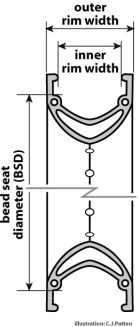
The ISO system uses two numbers. The first is width in millimeters. For the rim, this is the inner width between the flanges, as shown in the diagram; for the tire, it is the inflated width. This will vary a bit depending on the width of the rim.
The second ISO number is the critical one: it is the diameter of the bead seat of the rim, in mm ("B.S.D."). Generally, if this number matches, the tire will fit onto the rim; if it doesn't match, the tire won't fit.
For example, a 700 x 20 C road tire would be a 20-622; a 700 x 38 hybrid tire would be a 38-622. The width difference between these sizes would make them less-than ideal replacements for one another, but any rim that could fit one of them would work after a fashion with the other.
A general guideline is that the tire width should be between 1.45/2.0 x the inner rim width.
If you pull the beads apart and measure the total width from bead to bead, it should be approximately 2.5 x the ISO width.
If your tire is too narrow for the rim, there's an increased risk of tire/rim damage from road hazards.
If its too wide for the rim, there's an increase risk of sidewall wear from brake shoes, and a greater risk of loss of control in the event of a sudden flat.
The tables below give a partial listing of traditional tire sizes, with their ISO bead-seat equivalents. The ISO comparison list at the bottom of this page covers all sizes which we know to be in production as of 2016. The fractional, decimal and French lists cover common sizes.
| Fractional | ISO | Applications |
|---|---|---|
| 36 inch | 787 mm | Unicycles, some novelty bicycles |
| 32 inch | 686 mm | Unicycles, some novelty bicycles |
| 29 inch | 622 mm | This is a marketing term for wide 622 mm ("700C") tires. |
| 28 x 1 1/2 | 635 mm | English, Dutch, Chinese, Indian Rod-brake roadsters (Also marked F10, F25, 700 B) |
| 622 mm | (F.13) Rare Canadian designation | |
| 28 x 1 5/8 x 1 1/2 |
Northern European designation for the 622 mm (700 C) size | |
| 635 mm | Old Swedish designation | |
| 27 x anything except "27 five" and 609 mm Danish | 630 mm | Older road bikes. |
| 27 x 1 1/2 | 609 mm | Rare Danish size |
| 26 x 1 (650 C) |
571 mm | Triathlon, time trial, small road bikes. Old Schwinn S-4 |
| 26 x 1 1/4 | 597 mm | Older British sport & club bikes |
| 26 x 1 3/8 (S-6) |
Schwinn "lightweights" | |
| 26 x 1 3/8 (E.A.3) | 590 mm | Most English 3-speeds, department-store or juvenile 10 speeds |
| 26 x 1 1/2 (650B) | 584 mm | French utility, tandem and loaded-touring bikes, a very few Raleigh (U.S.) & Schwinn mountain bikes. |
| 26 x 1 3/4 (S-7) |
571 mm | Schwinn "middleweight" cruisers |
| 26 x 1, 1 1/8 | High performance wheels for smaller riders, common on Cannondale bicycles | |
| 24 x 1, 1 1/8, 1 3/8 | 520 mm | High performance wheels for smaller riders, BMX; Terry front |
| 24 x 1 1/8 | 520 mm or 540 mm! |
Caveat emptor. 540mm is common on wheelchairs. |
| 24 x 1 1/4 | 547 mm | British or Schwinn Juvenile |
| 24 x 1 3/8 (S-5) |
Schwinn Juvenile lightweights | |
| 24 x 1 3/4 (S-7) |
520 mm | Schwinn "Middleweights" |
| 24 x 1 3/8 (E-5) |
540 mm | British Juvenile, most wheelchairs; common on women's utility bicycles in Japan. |
| 22 x 1 3/8 NL | 489 mm | Dutch juvenile |
| 20 x 1 1/8 20 x 1 1/4 20 x 1 3/8 |
451 mm | Juvenile lightweights, BMX for light riders, some recumbents, some folding bicycles |
| 20 x 1 3/4 | 419 mm | Schwinn juvenile |
| 20 x 2 | 438 mm | Swedish |
18 x 1 3/8 |
400 mm | British juvenile. 18 x 1 is used on "micro" and smaller BMX bicycles |
| 17 x 1 1/4 | 369 mm | Alex Moulton AM series |
| 16 x 1 3/8 | 349 mm | Older Moulton; Brompton & other folders, recumbent front, juvenile |
| 16 x 1 3/8 | 337 mm | Mystery tire |
| 16 x 1 3/8 | 335 mm | Polish juvenile |
| 16 x 1 3/4 | 317 mm | Schwinn Juvenile |
| 14 x 1 3/8 | 298 mm | Moulton mini, etc. |
| 12 1/2 x anything | 203 mm | Juvenile, scooters |
| 10 x 2 | 152 mm | Wheelchair caster |
| 8 x 1 1/4 | 137 mm | Wheelchair caster |
Traditionally, fractional sizes are made for straight-sided rims. High-performance sizes (520 mm, 571, 622 mm etc.) are preferably used with hook-edge rims, which can hold higher pressure and center the tires more reliably. Tubeless tires may use special hook-edge rims that form an airtight seal.
| Decimal | ISO | Applications |
|---|---|---|
| 29 inch | 622 mm | This is a marketing term for wide 622 mm ("700C") tires. |
| 28 x decimal | Some German tire companies use this non-standard designation for 622 mm ("700C") tires -- violates Brown's law! | |
| "27 five" (meaning 27.5) | 584 mm | Marketing term for wide, knobby 584 mm tires. Some Mountain bikes |
| 26 x 1.00 through 5.0 | 559 mm | Most Mountain bikes, cruisers, fatbikes etc. Old Schwinn designation was S-2 |
| 26 x 1.25 (rare) | 599 mm | Very old U.S. lightweights |
| 26 x 1.375 (rare) | Very old U.S. lightweights | |
| 24 x 1.,5 (Dutch, rare) | 534 mm | Still made in India as of 2022 |
| 24 x 1.5-24 x 2.125 | 507 mm | Juvenile mountain bikes, cruisers |
| 22 x 1.75, 22 x 2.125, 2.1 2.3, 2.4 | 457 mm | Juvenile; BMX "cruiser" category (over 22 1/2" OD), street, freestyle for adult riders |
| OS 20 x 1.6, OS 20 x 1.75, OS 20 x 1.85 |
451 mm | Adult-size BMX racers. Under 22 1/2" OD to fit into "class" category. |
| 20 x 1.5-20 x 2.125 | 406 mm | Most BMX, juvenile, folders, trailers, some recumbents |
| 18 x 1.5 | 355 mm | Birdy folding bikes |
| 18 x 1.75-18 x 2.125 | Juvenile | |
| 16 x 1.75-16 x 2.125 | 305 mm | Juvenile, folders, trailers, Strida, early DaHon, some recumbents |
| 14 x 1.75-14 x 2.125 | 254 mm | Juvenile |
| 12 1/2 x anything | 203 mm | Juvenile, scooters |
In the French system, the first number is the nominal outside diameter in mm, followed by a letter code for the width: "A" is narrow, "D" is wide. The letter codes no longer correspond to the tire width, since narrow tires are often made for rim sizes that originally took wide tires; for example, 700 C was originally a wide size, but now is available in very narrow widths, with actual outside diameters as small as 660 mm.
| French Size | ISO | Applications |
|---|---|---|
| 700 A | 642 mm | Obsolete |
| 700 B | 635 mm | Rod-brake roadsters. |
| 700 C | 622 mm | Road bikes, hybrids, "29 inch" MTBs. (28 x 1 1/2 F.13 Canada) |
| 700 D | 583 mm | Oddball size formerly used on some GT models. Often incorrectly reported as 587 mm. 650B tire (584 mm) is close enough. |
| 650 A | 590 mm | French version of 26 x 1 3/8; Italian high-performance bikes for smaller riders |
| 650 B | 584 mm | French utility bikes, tandems, and loaded-touring bikes; some older Raleigh and Schwinn mountain bikes. Also called 27 five. We have a page about this size. |
| 650 C | 571 mm | Triathlon, time trial, high performance road bikes for smaller riders |
| 600 A | 540 mm | European Juvenile road bikes, most wheelchairs |
| 550 A | 490 mm | European Juvenile road bikes |
| 500 A | 440 mm | European Juvenile, folding |
| 450 A | 390 mm | European Juvenile |
| 400 A | 340 mm | European Juvenile |
| 350 A | 288 mm | European juvenile |
| Bead Seat Diameter, mm | Bead Seat Radius, mm | Traditional Designations |
|---|---|---|
| 787 | 393.5 | 36 inch |
| 686 | 343 | 32 inch |
| 642 | 321 | 700A |
| 635 | 317.5 | 28 x 1 1/2, 700 B, 28 x 1 5/8 x 1 1/2 (old, Sweden) |
| 630 | 315 | 27 x anything except "27 five" and 609 mm |
| 622 | 311 | 700 C, 28 x 1 5/8 x 1 1/2 and other pairs of numbers, (but also see 635), 29 inch, 28 x 1 1/2 F.13 Canada |
| 609 | 304.5 | Rare Danish size, 27 x 1 1/2 |
| 599 | 299.5 | 26 x 1.25, x 1.375 -- old US size |
| 597 | 298.5 | 26 x 1 1/4, 26 x 1 3/8 (S-6) |
| 590 | 295 | 26 x 1 3/8 (E.A.3), 650 A |
| 584 | 292 | 650B, 26 x 1 1/2, "27 five" |
| 583 | 291.5 | 700 D -- oddball size made by GT |
| 571 | 285.5 | 26 x 1, 26 x 1 3/4, 650 C |
| 559 | 279.5 | 26 x 1.00- x 2.125, also fatbike tires up to 5 inches wide |
| 547 | 273.5 | 24 x 1 1/4, 24 x 1 3/8 (S-5) |
| 541 | 270.5 | 600 A |
| 540 | 270 | 24 x 1 1/8, 24 x 1 3/8 (E.5), |
| 534 | 267 | Dutch 24 x 1.5 |
| 520 | 260 | 24 x 1, 24 x 1 1/8, 24 x 1 3/8, 24 x 1 3/4 |
| 507 | 253.5 | 24 x 1.5- x 2.125 |
| 501 | 250.5 | British, 22 x 1 3/8, 22 x 1.00 |
| 490 | 245 | 550 A |
| 489 | 244.5 | Dutch juvenile 22 x 1 1/8 NL, 22 x 1 3/8 NL |
| 484 | 242 | 550 B |
| 457 | 228.5 | 22 x 1.75; x 2.1, x 2.125, x 2.3, x 2.4 |
| 451 | 225.5 | 20 x 1 1/8; x 1 1/4; x 1 3/8; OS20 x 1.6, 1.75, 1.85 |
| 440 | 220 | 500 A |
| 400 | 200 | 18 x 1 3/8, 18 x 1 |
| 438 | 219 | Dutch juvenile, 20 x 1 3/8 NL |
| 428 | 214 | Swedish, 20 x 2 |
| 419 | 209.5 | 20 x 1 3/4 Schwinn Juven |
| 406 | 203 | 20 x 1.5- x 2.125 |
| 400 | 200 | 18 x 1 |
| 390 | 195 | 450 A |
| 369 | 184.5 | 17 x 1 1/4 |
| 355 | 177.5 | 18 x 1.5- x 2.125 |
| 349 | 174.5 | 16 x 1 3/8 |
| 340 | 170 | 400 A |
| 337 | 168.5 | 16 x 1 3/8 |
| 335 | 167.5 | 16x 1 3/8 Polih juvenile |
| 317 | 158.5 | 16 x 1 3/4 |
| 305 | 152.5 | 16 x 1.75- x 2.125 |
| 298 | 149 | 14 x 1 3/8, Moulton Mini |
| 288 | 144 | 350 A |
| 254 | 127 | 14 x 1.75 |
| 252(?) | 126.5 | 12 x 1/5/8 (France). 254 will work - build up rim with tape. |
| 203 | 101.5 | 12 1/2 X anything. |
| 152 | 76 | 10 x 2 |
| 137 | 68.5 | 8 x 1 1/4 |
Although you can use most tire/rim combinations that share the same bead-seat diameter, as already noted, it is unwise to use widely disparate sizes.
If you use a very narrow tire on a wide rim, you risk pinch flats and rim damage from road hazards.
If you use a very wide tire on a narrow rim, you risk sidewall or rim failure. This combination causes very sloppy handling at low speeds. Unfortunately, current mountain-bike fashion pushes the edge of this. In the interest of weight saving, most current mountain bikes have excessively narrow rims. Such narrow rims work very poorly with wide tires, unless the tires are overinflated...but that defeats the purpose of wide tires, and puts undue stress on the tire fabric and rim sidewalls.
The "fatbike" phenomenon has led to the availability of very wide tires and rims. These should only be used together.
Georg Boeger has kindly provided a chart showing recommended width combinations:
| Which tyre fits safely on which rim? [all dimensions in millimeters] |
||||||||||||||
|---|---|---|---|---|---|---|---|---|---|---|---|---|---|---|
| Tyre width | ||||||||||||||
| Rim width (interior) |
18 | 20 | 23 | 25 | 28 | 32 | 35 | 37 | 40 | 44 | 47 | 50 | 54 | 57 |
| 13 | X | X | X | X | ||||||||||
| 15 | X | X | X | X | ||||||||||
| 17 | X | X | X | X | X | |||||||||
| 19 | X | X | X | X | X | X | ||||||||
| 21 | X | X | X | X | X | X | ||||||||
| 23 | X | X | X | X | ||||||||||
| 25 | X | X | X | X | X | |||||||||
Note: This chart may err a bit on the side of caution. Many cyclists use slightly wider tires with no problem.
The cross-section of a tire's fabric is an arc of a circle -- only a full circle with tubulars. The rim takes up the part of the circle that is not represented by the tire.
The rim is typically 0.7 times as wide as the tire, and a bit of trigonometry will get you that the rim occupies about 90 degrees of what would be the circumference of the circle. The tire occupies the other 270 degrees (3/4 of the circle) and so the width when mounted on the rim is 4/(3 * pi), about 0.4, times the width when laid out flat.
Rim and tire widths of course vary, so this result is not exact.
A suggestion to measure tire width with the tire laid out flat first appeared in the third edition of Sutherland's Handbook for Bicycle Mechanics (1980), and I (John Allen) authored that suggestion.
That edition also included the first published tire-size chart using the ETRTO marking standard, other than in the original ETRTO technical document. I performed the calculations for the chart on a Hewlett-Packard Model 27 pocket calculator.
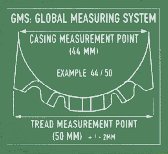 GMS Global Measuring System: The current industry standard for specifying the actual inflated size of a bicycle tire does not account for subtle variation in tread and casing size. To address this problem and provide you with more information for comparing tires, WTB has introduced the Global Measuring System (GMS) for tire measurement.
The GMS uses a two-number system: the first number is the width of the casing, and the second number is the width of the tread, both in millimeters. These measurements are taken on a rim which is 20 mm wide at the bead-capturing point, with a tire inflated to 60psi and maintained for 24 hours.
In addition to being able accurately to size a tire, knowing the actual casing size and tread width provides an indication of air volume, tread characteristics and tread contact area; all of which provide you with a more concise idea of what ride characteristics to expect from each of WTB's tires.
Tubular tires are mainly used for racing. A tubular tire has no beads; instead, the two edges of the carcass are sewn together (hence the term "sew-up") with the inner tube inside. Tubulars fit only on special rims, where they are held on by cement.
Unless special track-racing cement which does not allow on-road replacement of a tire is used, tubulars "squirm" against the rims and are slower than the best wired-on tires, even though lighter -- see details from Jobst Brandt.
Tubulars existed in several different sizes, but only 700c and 26-inch tubulars are readily available these days. Beware: sizes of 26" and 24" tubulars are not well-standardized. Take the rim with you when buying a tire, and vice versa. Size variations of tubulars are covered in Sutherland's Handbook for Bicycle Mechanics, 7th Edition, available from Sutherland's, and on the mechanic's bookshelf at better bike shops.
In clincher tires, there is a real difference between "700c" and "27 inch" sizes, but for tubulars this is a false distinction. Whenever you see mention of "27 inch tubulars" the writer is actually referring to standard full-sized tubulars, as used on most racing bikes.
If you want to sound like an ignorant yahoo, call them "tubies" or "tubeless tires." Tubeless tires for bicycles have bead wires, and are special only in being designed to hold air without an inner tube.