Considering Carbon

|




As I've reviewed, reformatted and updated Damon Rinard's pages on this site, I've gained some new perspectives on carbon fiber bicycle frames. Rinard intriguingly brings these frames into the realm of do-it-yourself work which is central to the site's mission. I had never before considered that carbon-fiber would be easier to work with than steel in a do-it-yourself project -- though I recall now that students were constructing kayaks from glass-fiber epoxy outdoors when I was a student at Middlebury College, before 1970 -- different fiber, same technology. Rinard also offers a scientific look into the design and performance of carbon-fiber frames.
Damon Rinard's carbon-fiber bicycle which he built in his garage
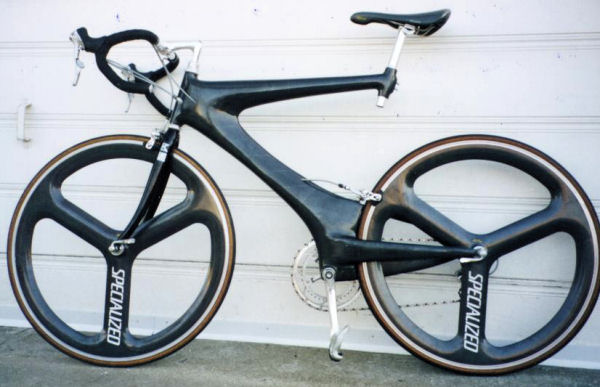
I'm not a racer, and so, no weight weenie. I'm cognizant of the reputation of carbon fiber for unexpected, catastrophic failure. On the other hand, we do have to think about carbon: understanding of it is improving, it is now common, it offers a weight advantage which is important to racers, and getting more people interested in building their own bicycles can only lead to a larger and more knowledgable cadre of builders and designers.
[Sheldon had serious reservations about carbon fiber, though he did buy, ride and enjoy a bicycle with a carbon-fiber front fork and rear triangle. The paragraphs below are some of the last he wrote, in 2008. I found them in a collection of new files which Sheldon had not yet published. I've inserted comments where Sheldon's information is outdated, and in one case incorrect. -- John Allen]
Sheldon's Raleigh Cadent bicycle
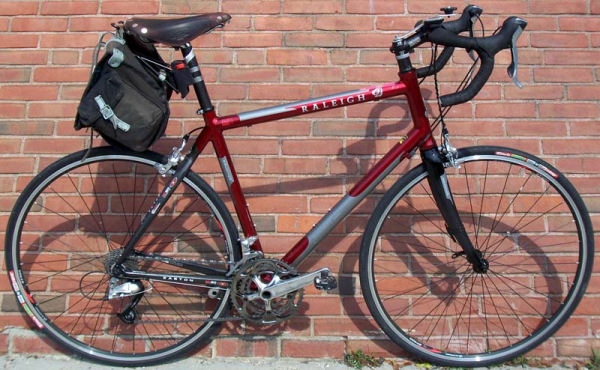
I don't believe that there are yet any really good mathematical models of the stresses a bike frame undergoes in the real world. The rider is so much heavier than the frame, and is capable of moving in so many different ways that it is very challenging to try to model this accurately. [This was accurate as of 2008. Now, Trek, Specialized and Cervelo (probably more) have good simulation models.]
The technology of building bikes out of metal tubing is quite mature. The diamond-frame bike was invented in the 1880s, and thousands of very smart people have worked very hard to try to perfect it, fine-tuning tubing thickness, diameter and so on in a basically evolutionary process. It wasn't done by some geek with a piece of paper and a slide rule calculating stresses mathematically.
Early carbon-fiber bikes used carbon-fiber tubes attached to metal lugs in various ways, mainly by glue. This is a very poor use of a material like carbon fiber, and these frames had a very high failure rate. The beauty of materials like glass fiber and carbon fiber is that the layup can be fine-tuned to make it stronger where it needs to be, in the direction it needs to be, and lighter where it doesn't need to be strong.
Unfortunately, I don't believe we yet know enough about the stresses a bicycle frame must endure to be able to use this material optimally. That's also why things like the EFBe test [available among Rinard's pages, see link at the end of this article] are not all that persuasive to me. I have no doubt that it is possible to make a superb bike out of carbon fiber, but I don't have confidence that we know enough to be able to do it yet. [Testing has advanced, but also it could be argued that we don't yet know how to use steel optimally.]
Part of the problem is that people are trying to push the envelope to the ragged edge of the possible. I am not confident that currently available carbon fiber products have an adequate safety margin. I still have a vivid image in my mind from the 2003 Tour de France, of Lance Armstrong tumbling to the pavement as his top-of-the-line Trek broke underneath him on a mountain climb. Good thing he wasn't going fast when the frame failed. I've also heard of too many failures of carbon forks to be happy about those. I must admit to aesthetic concerns as well. I grew up when virtually all decent-quality bikes were lugged steel. I once built such a frame myself, and I'm comfortable with this very well-proven technology.
[Armstrong crashed because of interference from a spectator, and the chainstay broke when Jan Beloki was unable to avoid riding over the fallen bicycle. Armstrong was able to finish the stage on this bicycle with a broken chainstay, despite one mishap when it caused the chain to skip and he nearly crashed again. That mishap may be what Sheldon remembered.]
I'll close with a thought I've articulated before: Let's try to imagine two numbers...we don't know what the numbers are but a knowledgable cyclist can make a guess at their relative magnitude:
Now, I'm not really a racing-oriented guy, but I grew up when all decent bikes came with a lifetime guarantee on the frame. There's only one carbon fiber manufacturer I know of that does that, the only carbon fiber manufacturer that I have confidence in: Calfee.
[It could be interesting to check that claim again. In any case, most bicycle frames are taken out of service, abandoned or crashed, rather than failing in normal use. Warranty claims are rare.]
Many failures of carbon-fiber frames which you might see are often due in part to the market's fascination with light weight. Moderately heavy carbon frames are nearly indestructible (from makers who know what they're doing, anyway). I've often thought if the market would accept 200 grams [less than 1/2 pound] more frame weight, they'd have a totally crash-tolerant high performance frame. In fact, even with the low weights the industry delivers, the frames test stronger and longer-lived than benchmark steel frames from classic makers.
The carbon DIY movement is slowly growing: witness the homemade bamboo bike mini-trend.
OK, my turn.
The appeal of bamboo is, well, romantic, as a green, natural material. It's fibrous, like carbon fiber, but its characteristics are neither optimal nor reliably consistent.
I regard Sheldon's trusting only one manufacturer as dated. Design, manufacturing and testing have come a long way since 2008.The EFBe frame test which Robert Kühnen describes on this site shows that well-designed carbon fiber frames outperform steel and titanium frames when presented with heavy loads simulating pedaling out of the saddle. This is not the only loading which frames experience, but European Union and ISO regulations now require a much wider battery of tests. Major manufacturers conduct additional tests beyond those requirements.
Metal frames and components are assembled mostly of pre-made pieces, joined together by welding, brazing, or threaded fasteners, all mature technology, as Sheldon says. Carbon fiber parts, on the other hand, are built up in layers. The frame tubes of a modern carbon-fiber frame take shape only during final manufacture, resulting in possibilities for error which may be concealed under a surface which looks fine. 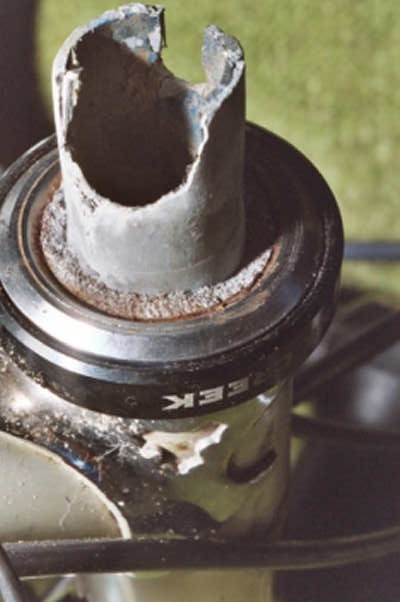 Poor design and manufacturing are by no means limited to carbon-fiber frames and components, but their newness, and the lack of experience with them, result in different problems.
The photo at the right shows one example of poor design from around 2001 which led to a crash. The pre-manufactured fork steerer tube was of carbon fiber-filled epoxy (bottom, fork-crown end shown, upside down), inside a thin shell of steel which supported the press-fit lower-headset crown race. Steel in contact with carbon fiber is prone to galvanic corrosion, which may have contributed to the failure here. The steel shell failed at the margin of the press-fit part, and then the carbon fiber broke suddenly during riding. A reinforcing tube inside the steerer tube, also of carbon fiber-filled epoxy, encircled the brake bolt and was apparently intended as a backup safety measure, but the brake bolt tore out. It sode not appear that the inner and outer tubes were bonded together.
Also, counterfeits have become a serious issue in the bicycle industry, and they are concentrated in the high-end market, among carbon-fiber frames and components.
Minor damage during the lifetime of a bicycle frame should be counted as normal, except in pro racing, where cost is no object and sponsors will hand a racer a new bicycle whenever there is any likelihood of a problem. A scratched or scraped carbon-fiber frame requires repair or replacement, for the sake of safety. A similarly damaged steel frame is often safe without repair.
In that connection, though, I disagree with Sheldon about the risk of losing in a race due to mechanical failure. There are many ways to lose a race, and the probability of losing increases with the number of contestants. Mechanical failure does not occur often enough to decrease the probability of winning by much. Also, a very slight advantage may win a race. As Robert Kühnen points out in his article, a bicycle which is reliable only for a single race may be entirely acceptable for a professional racer.

A racing mentality has been pervasive in the US bicycling market since the ten-speed boom of the 1970s, and has its worst effect in distorting the preferences of non-racers. A racing bicycle for everyday utility use makes about as much sense as a Ferrari for use as a family car. Even a fast recreational rider does well to accept a couple of percent decrease in speed to have a more reliable bicycle. With carbon fiber, the issue becomes more acute, as damage tolerance, not only practicality, comes into question.
As Rinard has noted, carbon fiber has great potential when the design goal is not the lightest possible weight, but rather a balance of characteristics. Of the bicycle frames which Rinard built in his garage, I consider the most interesting to be Betty's Bike -- one with a very low step-through frame -- which he built for an elderly woman who could no longer comfortably pick up the bicycle she had been riding, or lift her leg over it. Betty's bike was built not for lightest weight, but rather, for light weight consistent with reliability. Her smile tells the story. For her, this bicycle was totally a winner!
Last Updated: by John Allen