Bottom Brackets

|





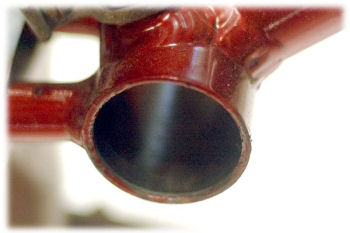 The bottom bracket is the part of the frame around which the pedal cranks revolve, also the bearings and axle assembly that runs through the bottom bracket shell of the frame.
The bottom-bracket shell may be unthreaded, like the one at the left (photo credit: ConnollyB, Wikimedia Commons), with bearing parts press-fit or clamped in place inside the shell. On the other hand, the bottom-bracket shell may be threaded internally at each end, so the bearing parts thread in. The bearing parts may be pre-assembled bearing cartridges or traditional cup-and-cone assemblies.
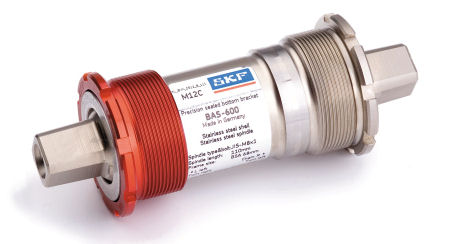
This pre-assembled bearing cartridge threads into a bottom bracket shell.
The cranks attach to the square tapers at each end and are secured by bolts.
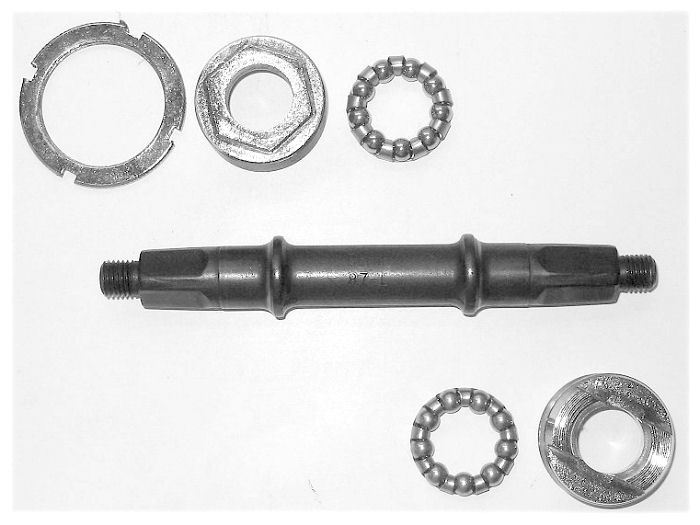
Traditional cup-and-cone bottom bracket parts: lockring, left bearing cup,
bearing retainer, spindle, bearing retainer, right bearing cup.
The bearing cups thread into the shell.
The cranks are secured to this spindle by nuts rather than bolts.
Photo by Rado bladteth Rzeznicki from Wikimedia Commons.
External
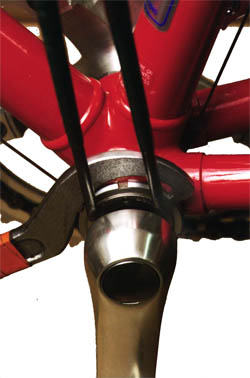
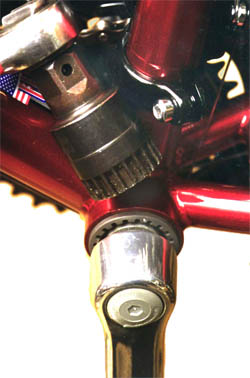
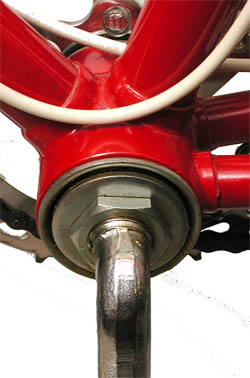
| A conventional cup-and-cone bottom bracket. The lockring wrench is about to loosen the lockring, the pin wrench is engaging two of the holes in the adjustable cup | A cartridge bottom bracket. The splined tool is shown above the bottom bracket. The crank would need to be removed to actually use the tool. | Old American-style "Ashtabula" One-piece Crank Bottom Bracket The lock nut and the cone behind it have a left-hand thread . The bearing cups face outward and are press-fit into the shell. |
 |
 |
 |
|---|
Bottom brackets come in different sizes, according to the nationality of the frame.
| Standard: | Threading | Adjustable (left) cup/cone direction |
Fixed (right) cup/cone direction |
Shell Width |
Applications/Notes |
|---|---|---|---|---|---|
| British I.S.O. |
1.370" X 24 tpi 1.375" X 24 tpi |
right | left | Standard 68 mm O.S. 73 mm |
The overwhelming majority of bicycles in current production. British and I.S.O. are interchangeable. |
| Shimano Hollowtech II, FSA MegaExo, RaceFace X-type | ISO | right | left | 90 mm, 95 mm including cups | External cups for cartridge bearings fit British/ISO threaded bottom brackets or unthreaded shell. 24 mm spindle, spacer to use 6805 bearings with 25mm I.D.. Bottom bracket shell must be faced so cups are parallel. |
| Campagnolo Ultra-torque | Italian or ISO | Spindle diameter 25mm. | |||
| Chater Lea | 1.450 x 26 TPI | right | left | Obsolete British size but available from Phil Wood & Co. | |
| French | 35 mm X 1mm (25.4 tpi) | right | right (wrong!) |
68 mm | Obsolete, used on older French bicycles. Prone to problems due to the right-threaded fixed cup, which tends to unscrew itself in use. |
| ISIS Overdrive I | 48 x 1.5 mm | right | left | 68mm 100 mm |
|
| ISIS Overdrive II | 48 x 1.5 mm | right | left | 68mm 100 mm |
New proposed standard oversized system. |
| Italian | 36 mm X 24 tpi | right | right (wrong!) |
70 mm | Italian and some high-end French bicycles. Prone to problems due to the right-threaded fixed cup, which tends to unscrew itself in use. |
| Phil Wood American Isis (comments) | 50 mm | right | left | 1.5 mm thread pitch. | |
| Raleigh | 1 3/8" X 26 tpi | right | left | 71 mm 76 mm |
Older British-made Raleighs, 3 speeds and others from the Nottingham factory. |
| Swiss | 35 mm X 1mm (25.4 tpi) | right | left | 68 mm | Same thread as French, but fixed cup is left- threaded for reliability. |
| Bottom Bracket Shell Threading (Below) |
BritishI.S.O. 1.37/1.375" x 24 tpi CUPS R-L (34.8/34.9 x 1.06 mm) |
Italian 36 mm X 24 tpi CUPS R-R (1.417" x 1.06 mm) |
French 35 mm X 1mm CUPS R-R (1.378 x 25.4 tpi) |
Swiss 35 mm X 1mm CUPS R-L (1.378 x 25.4 tpi) |
Raleigh 1 3/8" X 26 tpi CUPS R-L (34.9 x 1.06 mm) |
|---|---|---|---|---|---|
| British/I.S.O. 1.37/1.375" x 24 tpi (34.8/34.9 x 1.06 mm) |
Made to Fit | 36 mm Cup diameter is too large, thread won't even start. | Cup diameter is slightly too large, usually won't start. Right (fixed) cup threaded in the opposite direction. |
Cup diameter is slightly too large, usually won't start. |
Diameter matches, but thread pitch does not.
Will bind after only a few threads are engaged. |
| Italian 36 mm X 24 tpi (1.417" x 1.06 mm) |
British/I.S.O. cups fall through | Made to Fit | Italian shells are larger diameter, all other size cups fall right through, threads will not engage. | ||
| French 35 mm X 1mm (1.378 x 25.4 tpi) |
35 mm = 1.378". Shell is slightly larger, thread pitch slightly finer. Left side may seem to fit, but will be loose. |
36 mm Cup diameter is too large, thread won't even start. | Made to Fit | Left (adjustable) side is interchangeable. Right (fixed) side is threaded in the opposite direction, won't fit. |
35 mm = 1.378". Shell is slightly larger, thread pitch slightly coarser. Left side may seem to fit, but will be loose. |
| Swiss 35 mm X 1mm (1.378 x 25.4 tpi) |
35 mm = 1.378". Shell is slightly larger, thread pitch slightly finer. May seem to fit, but will be loose. | 36 mm Cup diameter is too large, thread won't even start. | Left (adjustable) side is interchangeable. Right (fixed) side is threaded in the opposite direction, won't fit. |
Made to Fit | 35 mm = 1.378". Shell is slightly larger, thread pitch slightly coarser. May seem to fit, but will be loose. |
| Raleigh 1 3/8" X 26 tpi (34.9 x 0.977 mm) |
Diameter matches, but thread pitch does not.
Will bind after only a few threads are engaged. |
36 mm Cup diameter is too large, thread won't even start. | Cup diameter is slightly too large, usually won't start. Right (fixed) cup threaded in the opposite direction. |
Cup diameter is slightly too large, usually won't start. | Made to Fit |
| Application | Dimension | Notes |
|---|---|---|
| Track/Coaster Brake Traditional One-Speed Most internal gear hubs |
40.5-42 mm | Older bikes with 110 spacing would be on the smaller end of this range Newer bikes with 120 mm spacing normally use 42 mm |
| Road Double | 43.5 mm | Shimano spec, measured to the midpoint between the rings. with typical 5 mm chainring spacing, this puts the inner at 41 mm, the outer at 46 mm. |
| Road Triple | 45 mm | Shimano spec, measured to the middle ring. |
| Singlespeed MTB Alternate |
47.5 mm | White Industries ENO hubs use this chainline, which lines up with the middle position of a typical MTB triple. It's also fairly close to the outer position of a typical "road" double. |
| MTB Triple | 47.5-50 mm | Shimano spec, measured to the middle ring. 47.5 preferred, but for frames with oversized seat tubes, the longer dimension may be needed, because the fat tube places the front derailer mechanism farther to the right. SRAM standard chainline is 49mm with 142mm OLD and thru axle |
| Singlespeed and Single-chainwheel MTB, "Boost 148" | 52 mm | Wider chainline need for chainstay clearance on newer MTBs, typically with disc brakes and 148 mm OLD spacing This is close to the chainline of the outer ring of a typical MTB triple. |
| Rohloff Speedhub | 54 mm (58 mm w/13 tooth) |
Sprockets are proprietary, threaded. All except the 13-tooth may be flipped over to double wear life. |
| Freeride and Downhill | 55 mm | Newer Freeride and Downhill bikes with 150 mm spacing |
| Tandem | about 60 mm | Tandems with 160 mm spacing |
| Fatbike | 66 mm | Fatbikes with 170 mm spacing |
| Fatbike | 76 mm | Fatbikes with 190 mm spacing -- needed with 4.8" (125 mm) wide tires. |
Standard bottom-bracket bearing assemblies are specified in terms of width of the bottom bracket shell (generally 68, 70 or 73 mm) and the length of the spindle (102 - 130 mm.)
Current usage generally assumes that 68 and 73 mm bottom bracket units are for British/ISO threaded frames, and that 70 mm units are for Italian threaded frames.
The spindle length mainly depends on what kind of crankset you'll be using, and doesn't have much to do with the frame. New cranks come with a spec sheet that lists what length spindle they are intended to be used with. Sometimes two lengths are listed. When this is the case, the longer size is for use on frames with fat seat tubes, because such frames put the front derailer mechanism farther to the right than on a frame with a standard seat tube.
See also my article on Bottom Bracket Sizes for information on matching spindles to cranks.
See also my article on Bottom Bracket Tapers.
My Tool Tips series includes related articles on Cottered, and Cotterless crank removal, as well as tools for disassembly and adjustment of cup-and-cone bottom brackets.
Last Updated: by Author