Shifter types and Choices

|


A skillful bicyclist shifts often – sometimes keeping the bicycle in one gear for only a few pedal strokes. Braking is often needed along with downshifting, especially in urban riding. A hand may need to be liftend from the handlebar to make a hand signal, pick up a water bottle, etch. Different types of handlebars, brake levers and shifters accommodate these qualities to different degrees.

With derailer gears, shifters on the downtube were the most common for decades.
The cables are shorter than with any other kind of shifters, and follow frame tubes. All other things being equal, shifting is crisper than with other shifters, and cables are less likely to be damaged due to careless handling or storage of the bicycle.
On the other hand (sorry!), a hand has to be removed completely from the handlebar to shift, and the cyclist has to be leaning forward for the hand to reach these shifters: they were not very practical with an upright riding position. Some older shifters along the seat tube or right chainstay required even more acrobatics.
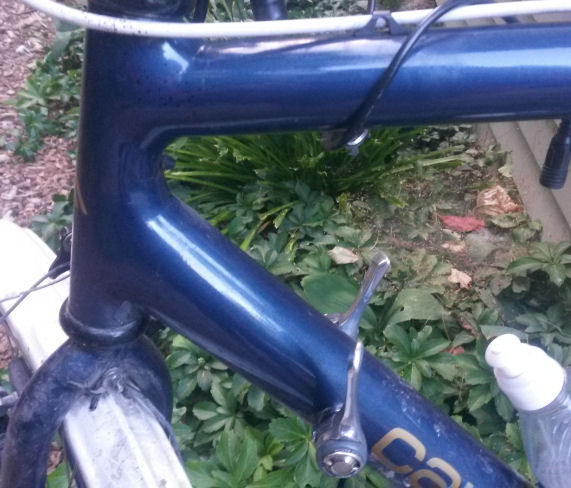
Both levers can be shifted with one hand -- with either hand. (Exception: bicycles with short frames and fat tubes, so the hand can't reach under the top tube to get to the opposite side of the down tube. Many early Cannondales were like this. even if the rame is tall enough so the hand can reach through, the wide spacing between the levers makes shifting with one hand more difficult.
The tubes of this old Cannondale are far enough apart to reach both downtube shifters
with one hand, but operating both at once is difficult because of their wide spacing.
The ends of drop bars and other kinds whose ends face rearward are a convenient place to attach shifters. Note that the bolt inside the shifter must turn counterclockwise to tighten and clockwise to loosen. It is not left-threaded: rather, you are turning the back end of th bolt which expands wedges inside the handlebar -- same issue as when adjusting spokes.
SunTour Barcon handlebar-end shifters became quite popular in the 1980s as a retrofit. These shiifters have a clever mechanism with a spiral spring which counteracts the tension from the cable. The index finger and thumb can grip the handlebar while the palm of the hand rotates the lever down. The middle and ring fingers pull the lever up. Braking is not possible with the hand that is shifting. Opposite hands shift the front and rear derailers..Which brake can be applied while shifting depends on which derailer is being shifted.
Downtube and bar-end shifters have levers that move through a range of positions and let you know by touch alone what gear you are using,, so you don't have to take your eyes off the road. In the days of five-speed freewheels and downtube shifters, the lever positions for different sprockets were distinct enough wtihout indexing, though it was necessary to finesse the position of the lever to center the chain over the sprocket, mostly by listening to the noise it made. This worked poorly, of course, in the noise of urban traffic or a racing peleton.
Top-mount handlebar shifters for flat bars have similar advantages, and were the most popular kind in the early days of mountain biking.
Handlebar-stem shifters, along with brake extension levers. were a selling point on low-end 1970s 10-speeds. Neither worked well. The brake levers didn't allow full braking force to be applied, and the shift levers were difficult to operate because there was nothing to rest the hand abainst to stabilize it. The location of the stem shifters also posed a hazard.
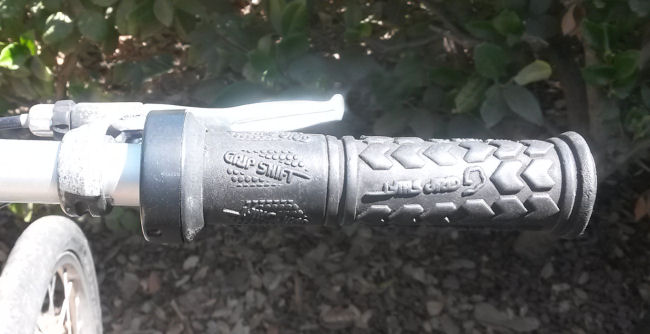
Shimano made twist-grip shifters for three-speed hubs as early as the 1960s. A spring pushed a bearing ball into a recess for each position; cable tension could cause unintentional shifts. Much later, Grip Shift, the company which later became SRAM, marketed better twist shifters with a ratcheting mechanism. Other manufacturers, notably Shimano, now also make them. Unlike top-mount shifters, handlebar-grip shifters allow shifting while the hand grips the handlebar, but not while braking with the same hand. With only a cylindrical hand grip, there is no way to tell by touch that the end of the gear progression is approaching. With handlebar-grip shifters, as with bar-end shifters, the hand available for braking depends on which hand is shifting.
An early Grip Shift. Newer ones have an indicator numbering the gears.
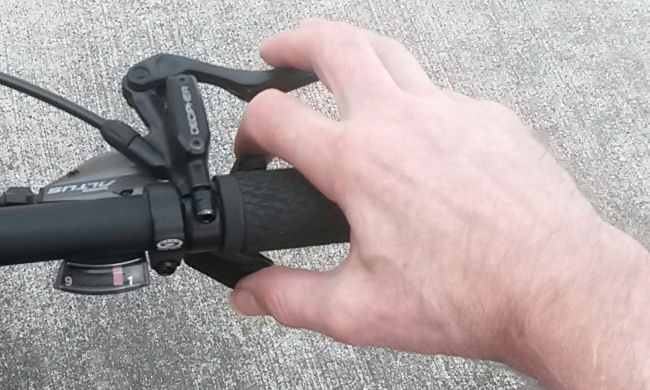
Modern Shimano, SRAM and Campagnolo shifters which are integrated into the brake-lever assembly allow shifting while also operating both handbrakes – but the levers return to the same position after every shift, so, as with handlebar-grip shifters, you know by touch what gear you are using only when you reach one or the other end of the sequence. Most of these shifters, like the one in the photo below, have an indicator but you must take your eyes off the road to check it. The thumb paddle downshifts the rear derailer, and at the left, upshifts the front derailer; vice versa for the paddle operated by the index finger.
Integrated shifter for flat bars. Braking is possible while upshifting and downshifting.
Unlike with all of the shifters described up to this point, integrated shifters can manage only one or at the most two steps with a single stroke of the lever. In one way, this is an advantage, because the chain is less likely to get hung up or overshift into the spokes, but also, downshifting takes more time.
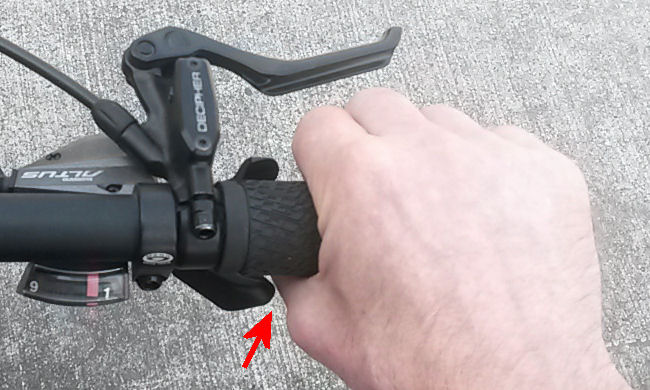
The flat-bar dual-paddle shifter shown in the photo below irritated the base of my thumb where indicated by the red arrow. The end of the paddle rests against the thumb when not in use, and has a sharp mold line. You win some, you lose some.
Indexing
Indexing shifters have been the norm for internal-gear hubs since their introduction around 1900. The Sturmey-Archer trigger shifter, introduced in the late 1930s, can be shifted either up or down with the index finger while keeping the other fingers over a flat-bar brake lever. Instructions from the time show how to locate the shifter.
Shimano was the pioneering company to introduce indexed downtube and bar-end shifters for derailer gearing
Coordination
Braking, signaling and shifting have to happen at particular times, and often at nearly the same time.
First of all, about braking: if you are skillful with the brakes, you will use the front brake for routine slowing and stopping on good pavement, as described in our article on braking and turning.
Which hand, then? The front brake requires more skill to use safely. Sheldon's advice is that if one hand is much better coordinated than the other, that hand should operate the front brake. Right-handed, he set up all his bicycles with the right-hand lever operating the front brake.
For a person with sufficient strength and coordination in both hands and just being introduced to handbrakes, the front brake should preferably be operated by the hand which is less in demand for other tasks. In countries where traffic keeps right, this is the right hand, because the left hand does most signaling. Here in the USA, that works for righties and agrees with Sheldon's advice. In countries where traffic keeps left, the left hand is less often needed for signaling. But also:
Contradictory, isn't it? It is easy to switch the cables around, It is much harder to re-train yourself. If you have developed skill in braking with the brakes set up one way, then stick with it. If you are new to handbrakes or haven't thought much yet about which lever operates which brake, then you might make

Most of the time, you'll want to be shifting either the front or the rear derailer, but, unless you are running a pure crossover shift pattern, there will be times that you'll need to do a double shift. This can either be done by shifting both front and rear derailers simultaneously, or doing one first, then the other right away.
Shifting both at once requires more skill, though with modern bicycles that have indexed shifting and the controls on the handlebars, it's nowhere near as tricky as it used to be.